Anna Burton
Beatrix Potter and the 'Timber Question': Arboreal Stewardship
in the English Lake
District
PLANT PERSPECTIVES 2/2 - 2025: 302–320
doi: 10.3197/whppp.63876246815902
Open Access CC BY 4.0 © The Author
Abstract
During Beatrix Potter’s residency in the English Lake District, trees were vital to her vision for and understanding of this landscape; much more than this, for this author, arboreal stewardship was bound up with being a good landowner and citizen in this region. This article explores Potter’s views regarding, and approaches to, tree planting, felling and the caretaking of timber on her land during the interwar period of the twentieth century, and at a particular time when the cultivation and conservation of this region’s trees were of national importance. Building on this context, and through a close reading of Potter’s tale, The Fairy in the Oak (1911), this study will explore how similar arboricultural impulses can be identified in the environmental ethics of the author’s earlier, fictional, writings too.
KEYWORDS
timber, tree felling, planting, Lake District, Beatrix Potter
 In an 1897 letter to Charles McIntosh, Beatrix Potter meditates on the connection between larch disease and the growth of Peziza mycelium on trees of this variety. Whilst Potter acknowledges that she has seen this fungi exist harmlessly in southern counties, she remarks that its prevalence in the Lake District has had a notable impact on the health of trees in that region and claims that ‘it is so bad in Westmoreland [sic] that one does not find a straight stem in 500’ specimens’.1 In reasoning why this is the case, she notes that the ‘woodmen think it is caused by replanting without cleaning up, & if the fungus is the cause they are right to some extent, because it breeds to an extraordinary extent on heaps of sticks’.2 The disease proliferates, Potter writes, because of poor work. The woodsmen have not ‘clean(ed) up’ after their fellings, which in turn, has created an ideal environment for fungal spores to spread on that same site; a localised concern which has an echo in the region today, with the current proliferation of a fungus-like virus, Phytophthora ramorum, that continues to result in mass fellings of larch across Cumbria.3 Whilst Potter’s letter demonstrates a contemporary botanical knowledge, this last passage also reveals a familiarity with arboricultural practice (and practitioners) in this landscape, in her time. Several years later, Potter would purchase her own land in the Lake District and, as this article will highlight, her personal writings and correspondence from her Lakeland years show a continued interest in and an acute responsibility for the appropriate planting, felling and caretaking of trees, within and across her property. Trees were vital to Potter’s vision for and understanding of this landscape; much more than this, for this author, arboreal stewardship was bound up with being a good landowner and citizen in this region.
Potter purchased her Sawrey homes, Hill-Top and Castle farms, in 1905 and 1909 respectively, then large tracts of land including Troutbeck Park in 1923 and the Monk Coniston estate from 1929, all of which were bequeathed to the National Trust in due course. In these spaces, Potter cultivated trees for a range of aims, for fruit and domestic produce, for aesthetic reasons and for economic purposes.4 Respecting Potter’s interest in timber during her Lakeland years, Linda Lear writes that Potter had a ‘ready pen to write on the subject of timber culture [and] developed particularly strong opinions on afforestation’ in the course of her farming endeavours;5 more recently, Meg Sherval notes that ‘protecting woodlands [became] particularly important to Potter … throughout her later years’, as tree cover offered ‘natural areas of protection’ for sheep.6 Potter was interested in planting and looking after tree spaces on her land, especially when it would be of benefit to her agricultural enterprise. Elsewhere, Matthew Kelly notes that, through work on her estates, ‘she recognised the commercial value of … plantations’, which, at the time ‘stood in stark contrast to mainstream preservationism’.7 For Kelly, and in contrast with many contemporaneous environmental thinkers, Potter appreciated the use of and place for plantation forestry in the region; in fact, it was an undertaking that was of financial benefit to the author and her estates. Though afforestation was not something that Potter wrote in direct public support of, this article will show that, in her private writings, she was particularly effusive about what she refers to as the ‘timber question’ and the nature of arboreal stewardship, more broadly.
Using her personal writings as evidence, this study will shed further light on the nuances within Potter’s opinions on (and actions relating to) the caretaking and cultivation of timber trees in the Lakes. Building on this, the article will explore how an arboreal ethic might be identified in Potter’s earlier letter stories to children, in the tale of The Fairy in the Oak (1911), in particular. In this fictionalised depiction of a felling, the reader might trace the author’s attitudes towards arboreal husbandry, how and why it is undertaken and the ecological and sociological impacts of such work. Potter’s interest in the stewardship of Lakeland trees and their caretaking pervades both her fictional writing and personal correspondences; much more than this, it was a concern from the beginning of her residency in the region. In order to better understand the arboreal resonances of her work in The Fairy in the Oak, however, a contextualisation of Potter’s later timber work and associated principles follows here.
Potter’s arboricultural principles
In a letter to Louie Choyce in 1939, Potter alluded to her ideas about and engagement with the subject of timber:
One job I am very interested in – is the timber question – also smothered with official red tape. There is a great shortage of pit props, partly owing to increased demand for the iron ore mines; and partly interruption of cargoes from northern Europe. It is a pity to see fine young larch go down, prematurely cut; but it is wanted.8
Potter acknowledges that ‘the timber question’ in the Lakes, at this point, was bound up with bureaucracy, ‘smothered’ in ‘red tape’ at the start of the Second World War. Whilst she mourns the premature felling of ‘fine young larch’ because it is not yet in its prime, she acknowledges that such timber is ‘wanted’ for and needed because of the war effort; pit props were needed for the mining of iron ore, which in turn, was wanted to produce ammunitions for the front. At the time Potter was writing, the debate over Britain’s need for its own domestic timber supply was rumbling on, at a national and localised level. The Forestry Commission was attempting to develop extensive conifer plantations in the uplands of Eskdale and Dunnerdale during the 1930s; whilst Friends of the Lake District and the Council for the Preservation of Rural England protested against these plans and campaigned for a restriction in the types of planting in the region. One of the foremost figures of the campaign, H.H. Symonds, put forward in his public reply to the Commission’s plans that ‘[the] Lake District pays its dividends already’; central to the protest was the concern that, whilst ‘it is common opinion among civilized persons that trees are beautiful … not all trees are equally beautiful in all places’.9 It was believed that trees were important to Lakeland culture, as perceived at local and national levels, and, much more than this, trees in the region were particularly valuable, simply because they existed in that landscape. Whilst Potter grieved impromptu felling in this letter, there is no attempt to intervene in this wider regional discourse and opposition to the Commission’s plans during this decade; she was practical, rather than sentimental, when it came to felling trees for timber.
On her own land, Potter was keen to produce timber that would, in turn, contribute to the further development and maintenance of her estates. In a 1926 letter to S.H. Hamer, the National Trust secretary at the time, she writes that ‘an estate should always have a stock of larch coming on, no matter what sentimentalists may say against the tree’.10 Unlike earlier arborists, Potter values this tree as its benefits as a crop outweigh any indulgent perspectives that one may have of its beauty. In the same letter she notes that she has larch plantings at Sawrey that will be ‘ready to thin in about 10-12 years’ and ‘[another] 5 acres of larch at the [Troutbeck Park] for replacing [the] pre-existing larch posts’ on that land, too.11 Potter was realistic about the usefulness of timber, with a mind to what amount an estate might need. She was also conversant with the economic value of such trees; when faced with any shortage, for instance, Potter was happy to sell larch stock for ‘£40 [or] £50’, especially any ‘inconspicuous trees that would not be missed’.12 However, this is not to say that she planted trees simply for economic or utilitarian purposes; in the same letter to Hamer, for instance, she discussed a desire to plant Scotch firs and oaks on her land, to create ‘a fairly large plantation’ at Troutbeck especially, one which would be both ‘ornamental & good shelter for [the] stock’ of trees therein.13 Potter’s larch plantings served a valuable, if functional purpose; these trees were part of the maintenance planned for her estate, but they also allowed for the eventual planting and cultivation of more trees, for both ornamental and utilitarian aims. A similar sentiment finds an echo in Potter’s magazine essay entitled, ‘Of Timber’, wherein she writes that ‘there are two points of view in considering trees; the aesthetic, and the commercial’.14 Whilst she is practical and mindful of the economic worth of trees, Potter advocates, in her personal and public writings, that trees should be viewed and valued for different purposes.
In moving on to discuss ‘the general question of cutting down trees’ in the aforementioned letter to Choyce, Potter continues to suggest that ‘1/3 of the trees in this district could be felled with positive advantage to the landscape, provided they were properly selected, and the remaining trees left in suitable groups’.15 In these terms – and in notable contrast to Symonds’s statements – felling might be a ‘positive advantage’ to the visual appearance of the Lakeland landscape, but such cropping should only take place when the trees are ‘properly selected’. For Potter, felling required a form of specialist knowledge, and a felling decision might be determined by the tree (species and specimen) as much as the environment in which it exists. When contemplating the felling of oaks in a magazine essay, for example, Potter acknowledges that, whilst these trees can be a nuisance to farmers (like herself), any individual should ‘think twice and thrice before [they] fell an oak. Generations of men and cattle will come and go before its like matures again’.16 Here, historic value demands a specific kind of reverence that should suspend the woodman’s axe. Potter warns that, though felling can be necessary, the worth of any tree should be weighed with a mind to other value systems, beyond the utility of the act itself.
Furthermore, Potter did not just dictate how others might plant or fell trees, but participated actively in the caretaking of trees on her land too. In the aforementioned letter to Choyce, Potter also tells her correspondent that ‘on the few fine days’ of weather, she ‘go[es] about with a paint pot’ marking trees that are to be felled and, at the same time, takes acorns around in her pocket to be ‘dibbled in’ the ground, where needed.17 Elsewhere, William Reginald Mitchell records a second-hand anecdote, wherein Potter tells the children of a local family that she had marked out specific fruit trees that they might use on her property, stating that ‘I have given you one apple and one plum tree. I have put a red band round them. You can have the fruit from those two trees’.18 At once, Potter is mindful and self-assured in her own assessment of trees that should be felled for visual and/or economic reasons in the present, or marked out and used for communal produce; and she also plants seeds that will become established specimens in that landscape in the future. Not only does Potter prioritise cultivating and tending to the trees on her property (which she is confident in undertaking), but there is the sense that she also aligned her own successful arboriculture with being a proficient landowner.
For this reason, Potter was also highly critical when cutting and planting on her land was not carried out to her exacting standards. In a letter to the National Trust regarding their appointed agent, Bruce Thompson, for example, she writes ‘[he] seems to have no sense at all’, ‘wastes time & wages in the woods’, does not undertake any ‘new plantings’, and always ends up ‘cutting down the wrong thing’.19 Potter’s writings and correspondence show that, from her perspective, planting and felling might be undertaken in a correct or incorrect manner. Tree cultivation requires skill and learning, the ability to comprehend whether a tree is of aesthetic or utilitarian value, and being cognisant of which has the most value in any given specimen and the environment in which it grows. This arboreal ethic and approach to caretaking can be identified in her letters, correspondence and essays from the 1920s–1930s, as her land ownership was expanding, but, as the second part of this article will illustrate through a close reading of The Fairy in the Oak, similar principles around timber and tree stewardship can also be identified at work, in her earlier Lakeland writings.
Fictional fellings
Potter first penned the story of The Fairy in the Oak in a letter to two young girls from New Zealand in 1911. The tale was subsequently adapted into a chapter for The Fairy Caravan collection and published for an American audience in 1929. Whilst this later version is perhaps most widely known – and though both versions of the narrative are alike in plot – as this discussion will demonstrate, the earlier letter-tale reveals a more place-specific attention to Lakeland tree cultures and cultivation. The Fairy in the Oak centres on a notable tree felling, as told by a narrator-version-of Potter and relayed by her friend, James, as he repairs her orchard wall. In this tale, James recalls when he ‘helped to take down an enormous oak’ near Coniston; but, as the narrator reveals and assures the reader, he ‘did not know that there was any fairy [in the tree or tale] at all’.20 James’s account frames the narrative, but it is the narrator who then conveys the full scope and ramifications of this felling. This story appears to exist between Potter’s personal and imaginary outlooks, within a fictionalised reality and an otherworldly domain, simultaneously. With Potter’s later statements around arboreal stewardship and the treatment of timber in mind, in this story’s depiction of a felling and those who participate in such an act, the reader might trace a continuity between Potter’s personal opinion(s) and the conceptualisation of her fictional environments.
In this tale, a fairy is displaced from her oak tree home by the Lake District council, who decide to cut down the ancient oak, ‘to make the high road safe for motor cars’.21 At the beginning of the narrative, the narrator emphasises the age and historic value of the ‘north country’ oak tree; whilst it is noted as being ‘younger than the Doomsday Oak’, it is a tree that was still notable for its number of ‘rings’, a tree that was ‘in its prime in Queen Elizabeth’s reign’.22 The narrator here emphasises that the worth of this particular tree is in its mature state; it is to be venerated in its age which transcends human scales of space and time. Whilst the planter of this tree is unknown, the narrator notes that the ‘man who plants and trains [such] an oak rears for himself a noble monument. Men may forget his name; but the tree grows clean and straight, through centuries, to thank him’.23 To plant an oak and tend to its success during a lifetime, is to ensure a living ‘monument’ for the planter, and the presence of a tree in the landscape for generations to come. The oak in this story, though of historical value in itself, is made even more significant by the fact that ‘the fairy of the oak’ had coexisted with this particular tree ‘for many hundred years’.24 As a result of this co-dependency, the tree also thrived ‘and grew straight and tall’.25 The fairy and tree are bound up in a symbiotic relationship; this exchange, though unknown to the Lake District council or James in the story, is another form of arboreal value, invisible to most, but perceived by the narrator here.
In the letter-tale, the actual cutting down of the tree is described in particularly violent terms. The process is detailed at length, as ‘the woodmen sawed [the tree’s] branches off painfully’ and with ‘a roar’ the tree is felled, ‘[the] arms of the tree were broken, and [the] fairy was stunned and lay still’.26 Penny Bradshaw affirms that here, just as the fairy ‘embodies’ the physical existence of this tree in the tale, the suffering of the tree is also articulated in forceful terms through the coeval experiences of this magical creature.27 Moreover, the felling in Potter’s tale is not only one of transcendent fairy magic; in the depiction of the felling process, the author also demonstrates a familiarity with the technicalities of this act in real-life terms. Alongside other surveying parties, Bruce Thompson – the aforementioned regional agent for the National Trust – appears in this earlier version of the tale, as a foremost figure in the planning process:
There was Mr Thompson and two members of the Highway Board on bicycles; and the Surveyor in a trap; with poles, a tape, the chain links, and the theodolite on three legs. They clambered about the rocks, and measured, and squinted through the theodolite. Then they made marks in note books, and hammered in pegs; got on their bicycles and rode away.28
Just as she identified trees to be cut or used on her own property with paint and bands, Potter lingers over the materials and materiality of assessing, measuring and marking this tree, and how the impacts of the felling are mapped out on that terrain. The cropping of this tree is depicted as a planned, plotted and quantified endeavour, not an indiscriminate felling. Whilst Potter would go on to critique ‘Mr Thompson’ severely in later correspondence, it is the unnamed ‘surveyor of the district council’ who is the responsible authority in these circumstances, as they have ‘no sentiment; and no respect either for fairies or for oak trees’ in proceeding with this felling.29 Blame is not laid at the feet of all timber workers equally; James, like most other men described here, is working under ‘orders’ from the district.30 The woodsmen are not villainised, in part, because they are simply unaware of the full scope of their actions.
Aside from Potter’s narrator, humans in these narratives cannot see the fae that are embedded within the natural world around them. In allowing the reader to move beyond what Laura Forsberg defines as the ‘veil’ of Victorian fairy literature, Potter allows her reader to see the ‘limitations of human vision’.31 The fairy is largely invisible, except that one of the woodsmen think they see ‘a little creature like a green squirrel, sitting on the trunk’; or, as the narrator suggests, a witness might question how far ‘all the noise in the wood was the grating noise of the saws’ or whether it ‘was the wind sighing in the pines, and the little tree fairies lamenting’.32 Perception, of sight and sound, is more limited for the humans in this story. Though the fairy herself remains invisible, her anger manifests physically as the woodsmen’s work progresses; as the men leave for the mill with the fallen tree, ‘horse—oak—and waggon were overturned’ by her influence, and though he cannot explain the ‘strange[ness]’ of the invisible threat enacting revenge on the workers, James notes that he was ‘glad to get away alive’.33 Whilst the narrator is not sympathetic towards this specific act of tree felling, and, as Marion Copeland argues, Potter’s work ‘posits that the loss of the “wild” drains the magic from the worlds of both human and nonhuman [beings]’; at the same time, the natural world in this tale remains a significant and lasting power that not all humans can (or do) fully recognise.34 Much like the act of tree felling as described in Potter’s letters, to perceive and acknowledge the complexity of such a value system attributed to trees in the landscape is a skill that needs to be cultivated by the humans in this story.
However, this tale is not a complete condemnation of human husbandry; in fact, Potter presents her reader with a compromise, for the humans and nonhumans in this environment. In the conclusion, it is made clear that, whilst the felling of a tree is a violent act, what is done with the arboreal remains of that tree, with its ‘[ ]* foot run of clean timber’, must then make that act a worthwhile one.35 After watching the men take the tree away to ‘Coniston Saw mill’, the fairy is left homeless and isolated from the woodland environs around her, until the sounds of ‘nails and hammers and saws’ nearby ‘stir [her] heart, and make [her] feet dance’ and lead her across the meadow to a ‘new bridge’ which has been ‘made of the fairy’s oak’.36 For the fairy, then, ‘there comes comfort after trouble, and usefulness out of pain’ in the creation of this bridge.37 Furthermore, this ‘usefulness’ is envisioned in a verse that closes the story:
Alike in summer and winter, the bridge stands firm and strong;
over blue rippling shallows and pebbles—or brown floods racing along.
The little toddling children, pass by to school, or play;
the farm wife with her basket—all take that shortened way.
The patient plodding horses, bend to the easier road;
and Something leads them over, and helps them to lighten their load.
It wears a duffle grey petticoat and a little russet-brown cloak;
And that is the end of my story of
The Fairy in the Oak.38
From the perspective of Potter-as-narrator, this specific oak tree should never have been cropped but, having been felled, it is important that such wood, ‘well seasoned by trial and tears’, is put to good use for communal purposes.39 Through this, the tree becomes an arboreal revenant; it is no longer growing ‘straight and tall’, but it returns as a ‘firm and strong’ entity within these environs.40 As Bradshaw argues, the denouement to this tale of suffering illustrates Potter’s more ‘pragmatic understanding’ of the relationship between nature and culture, and encourages ecological perspectives on the part of her young readers which are underpinned by an awareness of the ‘mutual reliance and connectivity’ between all inhabitants in the landscape.41 In these terms, the bridge that closes the story becomes a literal and notional crossing point for Potter’s environmental and arboricultural ideals.
The bridging and crossing of boundaries, between species, spaces and beings, is a conceptual interest across Potter’s tales for children. These crossings can be somewhat literal, for instance when Peter Rabbit escapes Mr McGregor’s garden under a wooden fence; or they can have a magical quality, as exemplified when a young child opens a door into the Lakeland hillside which transports her into the Mrs Tiggywinkle’s ‘nice clean kitchen’.42 In both of these anthropomorphic interactions, crossing over a physical threshold marks a human/non-human exchange (friendly or otherwise), and/or a blurring between wild and cultivated places. Moreover, Potter’s crossings can be transient or permanent in nature; for example, in The Tale of Pigling-Bland (1913), the titular pig and his companion ‘came to the bridge [that marked the county boundary]—they crossed it hand in hand—then [went] over the hills and far away’, an action that, as Pigling’s mother reminds him earlier in the tale, means somewhat inexplicably that ‘you cannot come back’.43 In contrast to the permanent rupture between two domains that occurs via the stone bridge here, the making of the wooden bridge – the felling and subsequent shaping of timber by human hands – in The Fairy in the Oak ends on a moment of vital and collaborative potential, which gestures to the continued occurrence of many future crossings, of further trans-species intimacies and sympathies. The continued co-existence of the fairy and the tree-as-bridge means that their previous unity persists in a new form, alongside human and non-human communities, and therefore becomes a model for mutual existence and companionship between species of all kinds.
In When Species Meet, Donna Haraway states that, across ecologies, ‘we are in a knot of species coshaping one another in layers of reciprocating complexity all the way down’.44 For Haraway, perceiving the complex web of biological, environmental, cultural and historical interactions that take place in any encounter between species must be considered for future meetings, in order to better ‘[get] on together with some grace’.45 This is not simply in human-animal-plant encounters but extends to all kinds of beings; to begin with, Haraway uses the example of a photograph of a tree stump in a forest, covered with moss, lichens and other organisms, that appears to look like a dog in a moment of imagined anthropomorphism. The author argues that this ‘postarboreal life’ is the product of ‘naturalcultural contact zones’;46 amongst other things, these comprise ‘practices of late nineteenth-century loggers who, without chain saws, cut the tree’, the climate, as well as ‘greenbelt policies’ that protect that land.47 This ‘postarboreal life’ is the result of an intermingling of natural and cultural elements, human and non-human influences, that in turn, co-shape it into something else. Just as Haraway sees a dog in a tree stump, the woodcutter in The Fairy in the Oak applies their own knowledge of the natural world (and what it contains) to explain their potential sighting of a ‘green squirrel’ during the felling. This is certainly another instance of Potter’s interest in species crossing but, in light of Haraway’s analysis, this blurring of ‘naturalcultural contact’ allows for further imaginative and ecological reflection on the part of the reader.
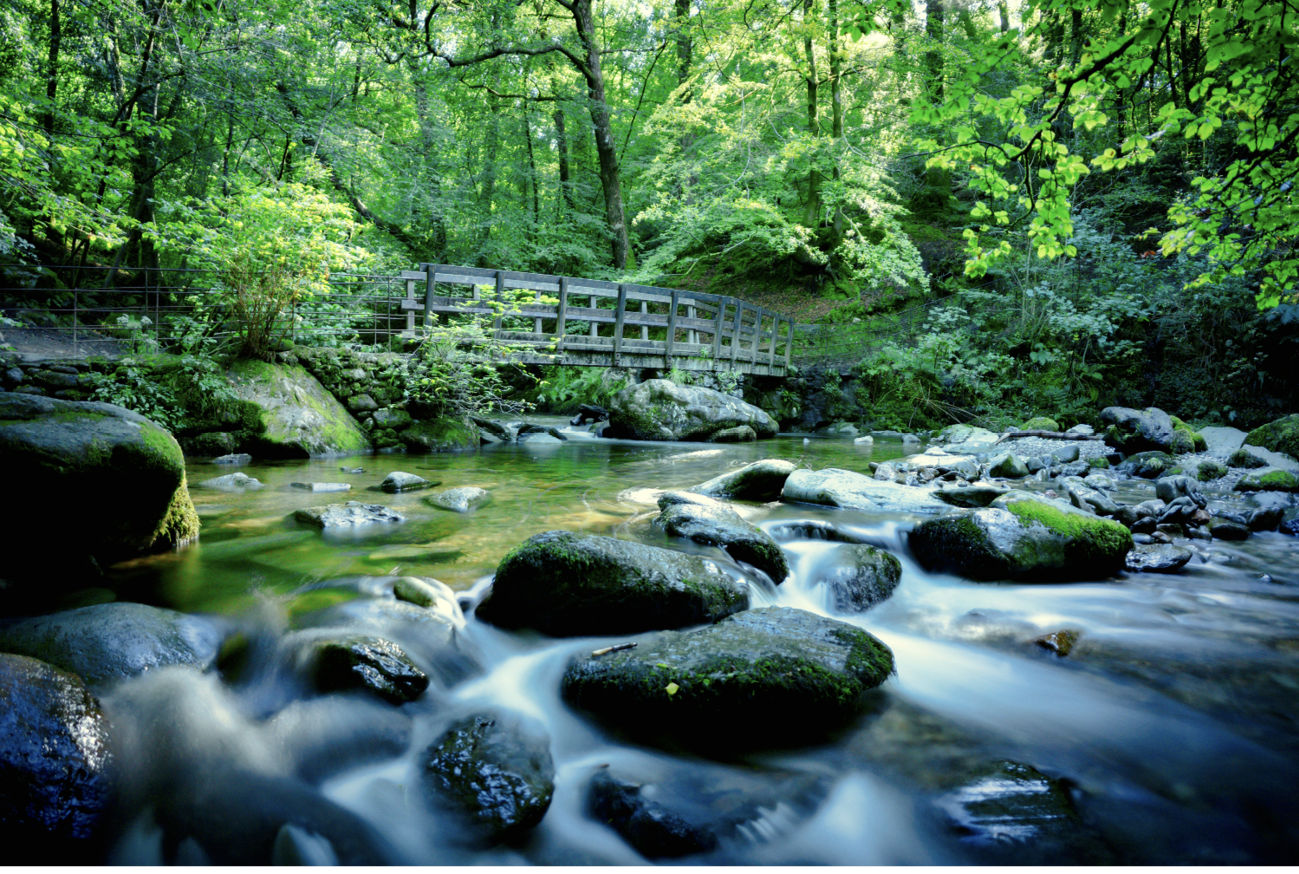
Figure 1.
Jonny Gios, Stock Ghyll River.
Source: Unsplash.
Whether it is a fairy or a squirrel, this creature is dislodged from their habitat; in the separation from its tree, this might be seen as an eco-spiritual loss of the ‘soul’ of the tree at the hands of commercial endeavour, or it can be read more literally as a loss of biodiversity in this woodland. The latter case here is especially striking, as the protection of upland oak woodlands in the Lakes – the ‘temperate rainforest’ of oak-dominated valleys in Borrowdale and Coniston – has recently been campaigned for by the Friends of the Lake District, amongst others, as a means to protect ‘the abundance of distinctive plant and animal communities’ therein.48 In the homelessness and sorrow of the fairy or ‘green squirrel’, the reader might chart an implicit or explicit environmental commentary in these spatial and species crossings. However, in the destruction of the tree and creation of the bridge still inhabited by the fairy, Potter also envisions a bittersweet form of ‘postarboreal life’; and, in this creation, the narrative offers amelioration for environmental degradation through mutual evolution. As well as being an object produced by commercial interests, this new form of co-existence is the product of suffering across creatures, humans and trees; this is a living narrative which might, in turn, also foster ecological thought (or as Haraway would have it, the desire to get on with other species, ‘with some grace’) in the reader.
Potter loved old oaks in their many forms and her interest in the ‘postarboreal’ also extended to her wider appreciation for objects made of timber, as can be seen in the material culture of wood products illustrated across her tales.49 From a young age, Potter had an interest in having ‘old furniture, oak in the dining room and Chippendale in the drawing room’;50 whilst, as landlord of several properties in the Lakes, she wanted to ‘collect any genuine pieces [of Lakeland oak furniture] to put back in the farmhouses’.51 These respective ambitions were realised in the substantial collection of old oak and mahogany furniture acquired and situated across her estate. Once again, Potter aspired to be a considerate landlord in keeping Lakeland furniture close to the site of cultivation, but this interest did not extend to products from across the globe. The fact that Potter sent this tale of English deforestation to two girls from New Zealand is also noteworthy in this context. As G.A. Barton writes, until after the Second World War, Britain largely ‘relied on its own colonies to supply such raw materials as timber’; it was only in 1913 – two years after Potter’s letter – that, as Barton notes, a royal commission on forestry urged Parliament to create a forestry department in New Zealand that might allow for ‘tight administrative control, and the planting of plantations to relieve the strain on indigenous forests and meet timber needs’.52 In light of this, it is certainly unfair to assume that Potter might have corresponded with two young girls on the ethics of imperial interests in forestry, especially when the tale might foster interest in trans-species intimacy and ecological thought, regardless of geographical focus. However, the juxtaposition of these contexts also draws attention to the geographical limitations in her conceptualisation of arboreal care and timber use at this time.
Potter’s interests in the ramifications of arboriculture and the ‘timber question’, in the treatment of actual trees and the shaping and maintenance of wood products, was expressly local. This is reaffirmed through a reading of The Fairy in the Oak’s conclusion, wherein the act of creating a communal bridge from the timber of the native tree gestures explicitly to the work of a particular millocrat and Lakeland improver, James Garth Marshall. Contemporary with Potter’s move to the Lakes, in his 1906 study, The Book of Coniston, W.G. Collingwood also makes explicit reference to the ‘bridges … put up by Mr Marshall and kept in repair by the Lake District association’.53 As Christopher Donaldson reveals in his study of Marshall’s improvements within the region, the landowner planted many trees and created dams at Tarn Hows, erected the sawmill at Far End in Coniston and made many changes for ‘public benefit’ within the Lakes, including the ‘installation of bridges, footpaths, and pony drives’ to expand access within the region.54 Whilst Potter’s story does not name Marshall as a figure, the sawmill at Coniston is named as the site of the oak’s timber transformation. Equally, as the landowner was known at this time for incorporating bridges, paths and pony access, within and around Coniston, the implementation and utility of the bridge at the end of The Fairy in the Oak aligns with Marshall’s improvements in this area specifically. This association is significant as it reveals that, from an early stage in her Lakeland years, Potter was conversant with localised arboricultural practices, how and where timber was treated and kept in the region, and the associated responsibility of these concerns as a landowner and landlord in the early twentieth century.
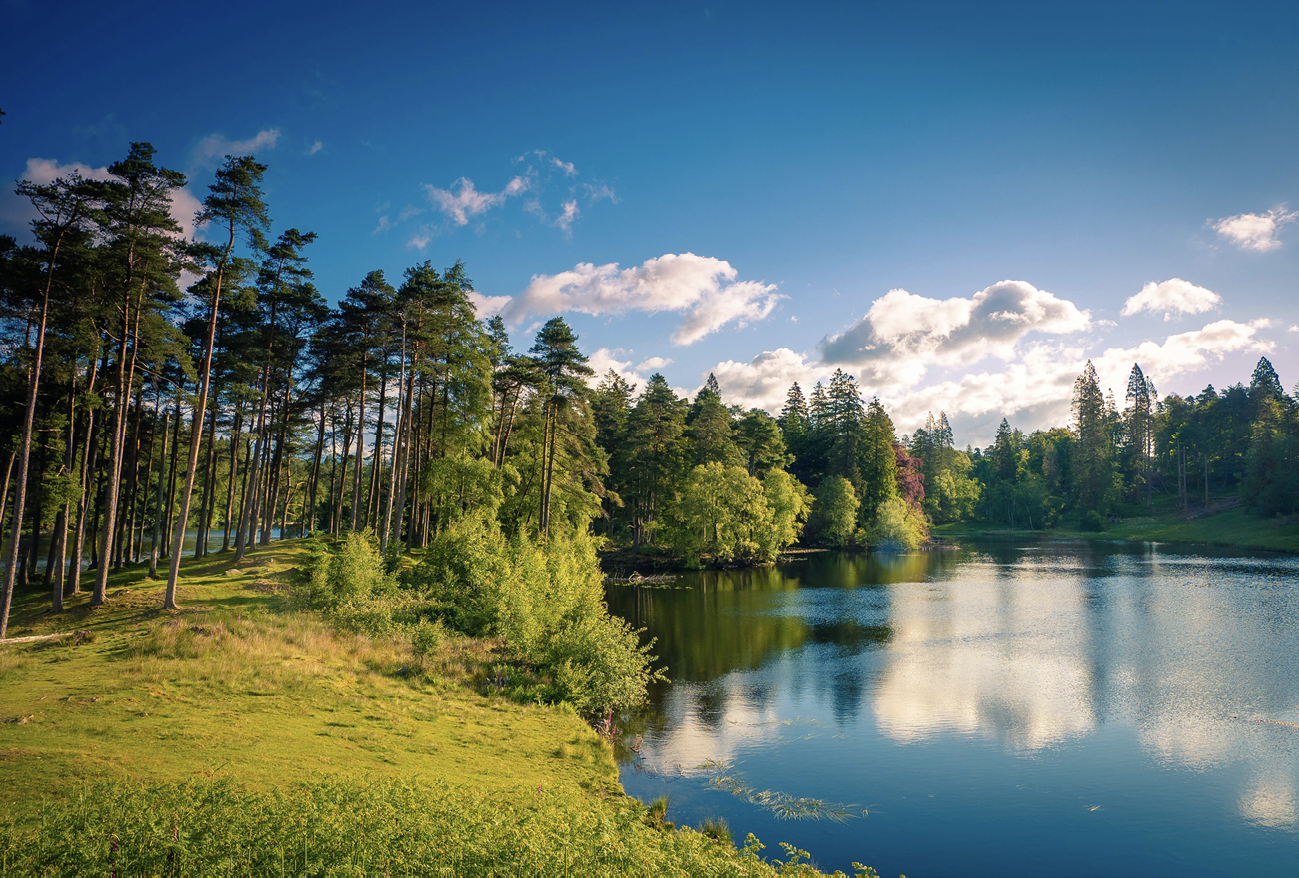
Figure 2.
Jonny Gios, Tarn Hows.
Source: Unsplash.
Tree cultivation, planting and felling would define and characterise Potter’s approach to maintaining her Lakeland properties. In particular, the author’s attitudes towards timber, whilst not particularly sentimental or global in nature, were informed by a spectrum of ideas about the caretaking of trees. With respect to felling trees in particular, for Potter, environmental, aesthetic and historical factors must be considered and balanced alongside economic and utilitarian concerns before any tree is cut down. This principle defines Potter’s later arboricultural work and commentary, but is also present in the earlier environmental ethics of her children’s tales set in the Lake District. In a subsequent letter-tale, The Oakmen (1918), written for the god-daughter of her husband, Potter conceptualised a further tale of timber cropping and arboreal relocation. In another narrative aimed at a child, the reader can trace Potter’s earlier concerns and ideas relating to arboreal stewardship. In this letter, Potter-as-narrator relays the story of a gnome-like collective living in a ‘big black wood’ of larch, who, like the fairy in the previous tale, are displaced by a felling act.55 Here, ‘two wood fallers … with axes’ reduce the Oakmen’s homes to ‘nothing but stumps, and chips, and trunks of trees’, leaving a number of gnomes ‘buried in chips’.56 Whilst the timber workers are distanced from the full extent of the blame, as there is no indication that they are aware of the magical creatures in the first place – with Potter’s earlier letter to Macintosh in mind – here the author is certainly critiquing the woodsmen’s careless job of felling the trees. The tale concludes with the transference of the Oakmen to a wood of ‘1700 little larches and 500 little spruces, like little Christmas trees’ that the author planted herself, next to Moss Eccles Tarn in Sawrey.57 In this later instance, the imaginary worlds of Potter’s writings are blended with her real-life plantings and cultivation, an endeavour that would then shape the author’s approach to landownership, beyond the pages of her correspondence, for subsequent decades.
ACKNOWLEDGEMENT
Many thanks to Dr Penny Bradshaw of the University of Cumbria for her consultation and kind permission to reference work from her forthcoming book An A-Z of Beatrix Potter (Bloomsbury Academic).
Anna Burton is a Lecturer in English Literature at the University of Derby and a specialist in representations of trees and woodland in nineteenth-century nature writing and environmental literature. Anna’s recent monograph, Trees in Nineteenth-Century English Fiction: The Silvicultural Novel, was published with Routledge in 2021. Her current research explores the cultural and literary history of tree planting, cultivation, and caretaking in the English Lake District. Alongside Amanda Blake Davis, she is also the co-lead of the Romantic Trees: The Literary Arboretum project and the Tree Cultures Network.
Email: A.Burton@derby.ac.uk
1 Beatrix Potter, Beatrix Potter’s Letters, ed. by Judy Taylor (London: Penguin, 1989), p. 40.
2 Ibid.
3 The National Trust, Our Work at Tarn Hows and Coniston: https://www.nationaltrust.org.uk/visit/lake-district/tarn-hows-and-coniston/our-work-at-tarn-hows-and-coniston (accessed February 2025).
4 The planting and caretaking of fruit trees was central to her homemaking at Sawrey. In a letter to Millie Warne in 1906, for example, she writes of ‘a most interesting performance’ of ‘putting liquid manure on the [old] apple trees’ at Hill-Top in the hope that they will continue to produce ‘good cookers’. See Potter, Letters, p. 148.
5 Linda Lear, Beatrix Potter: The Extraordinary Life of a Victorian Genius (London: Penguin, 2008), p. 279.
6 Meg Sherval, ‘Nature’s calling: Expanding the legacy of Beatrix Potter in the construction, contestation and contemporary preservation’, Literary Geographies 10 (1) (2024): 125–42, at 134.
7 Matthew Kelly, The Women Who Saved the English Countryside (London and New Haven: Yale University Press, 2023), p. 80.
8 Beatrix Potter, The Choyce Letters: Beatrix Potter to Louie Choyce, ed. by Judy Taylor (London: The Beatrix Potter Society, 1994), p. 67.
9 H.H. Symonds, Afforestation in the Lake District (London: J.M. Dent & Sons, 1936) pp. 8, 5.
10 Potter, Letters, p. 297.
11 Ibid.
12 Potter, Letters, p. 350.
13 Potter, Letters, p. 297.
14 Beatrix Potter, ‘Of timber’, in Leslie Linder (ed.) A History of the Writings of Beatrix Potter (London: Frederick Warne, 1971), pp. 394–95, at p. 394.
15 Potter, The Choyce Letters, p. 67.
16 Beatrix Potter, ‘Acorns’. In Linder (ed.) A History of the Writings of Beatrix Potter. pp. 393–94, at p. 394.
17 Potter, The Choyce Letters, p. 67.
18 William Reginald Mitchell, Beatrix Potter: Her Lakeland Years (Ilkley: Great Northern Books, 2010), p. 13.
19 Potter, Letters, p. 410.
20 Beatrix Potter, The Fairy in the Oak, in Linder (ed.) A History of the Writings of Beatrix Potter, pp. 351–56 at p. 352.
21 Ibid., p. 353.
22 Ibid., p. 352.
23 Ibid.
24 Ibid., p. 353.
25 Ibid.
26 Ibid., p. 354.
27 Penny Bradshaw, ‘Trees and the development of ecological understanding in the work of Beatrix Potter’, key-note paper presented at ‘The Literary Arboretum’ Symposium (Wordsworth Grasmere, July 2024). This key-note paper comprised research for Bradshaw’s forthcoming book, An A-Z of Beatrix Potter (Bloomsbury Academic, forthcoming 2025).
28 Potter, Fairy in the Oak, pp. 353–54.
29 Ibid., p. 353.
30 Ibid., p. 354.
31 Laura Forsberg, ‘Nature’s invisibilia: The Victorian microscope and the miniature fairy’. Victorian Studies 57 (4) (2015): 638–66, at 648.
32 Potter, Fairy in the Oak, p. 354.
33 Ibid., p. 355.
34 Marion W. Copeland, ‘The wild and wild animal characters in the ecofeminist novels of Beatrix Potter and Gene Stratton-Porter’, in Sidney Dobrin and Kenneth (eds), Wild Things: Children’s Culture and Ecocriticism (Detroit: Wayne State University Press, 2004), pp. 71–81, at p. 73.
35 Potter, Fairy in the Oak, p. 354. * Potter forgot to input an actual measurement in this instance – as Linder’s footnote reveals, she ‘left a space [in the letter] to put in the length’ – but the gap itself measures the author’s desire to prioritise and define the tree’s scale.
36 Potter, Fairy in the Oak, p. 356.
37 Ibid., p. 355.
38 Ibid., p. 356.
39 Ibid.
40 Ibid.
41 Bradshaw, ‘Trees and the development of ecological understanding in the work of Beatrix Potter’.
42 Beatrix Potter, The Great Big Treasury of Beatrix Potter (London: Random House, 1996), p.58.
43 Ibid., pp. 221, 207.
44 Donna Haraway, When Species Meet (Minneapolis and London: University of Minnesota Press, 2007), p. 19.
45 Ibid., p. 15.
46 Ibid., pp. 6, 7.
47 Ibid., p. 6.
48 Friends of the Lake District, Upland Oak Woodlands (2025): https://www.friendsofthelakedistrict.org.uk/faqs/upland-oak-woodlands-climate-change-facts (accessed Feb. 2025).
49 See Elizabeth Jacklin,. ‘“Chippendale in the drawingroom”: Beatrix Potter and furniture’, Furniture History 54 (2018): 279–91.
50 Beatrix Potter, The Journal Writings of Beatrix Potter, From 1881 to 1897: Transcribed from Her Code by Leslie Linder (London: Frederick Warne, 1996), p. 90.
51 Potter, Letters, p. 370.
52 G.A. Barton, Empire Forestry and the Origins of Environmentalism (Cambridge: Cambridge University Press, 2002), pp. 94, 120.
53 W.G. Collingwood, The Book of Coniston (Kendal: Titus Wilson, 1906), p. 5.
54 Christopher Donaldson, ‘Authorial effects at work in the English Lakes: the curious case of Tarn Hows’, Nineteenth-Century Contexts 42 (4) (2020): 433–48, at 437.
55 Beatrix Potter, The Oakmen, in Linder (ed.) A History of the Writings of Beatrix Potter, pp. 240–42, at p. 242.
56 Ibid., pp. 241, 242.
57 Ibid., p. 242.