 a tinge less beautiful
just to reiterate:
it isn’t yew but me
stands hollow-hearted in the churchyard
in shades of Eliza
mistaking common ground
inclined to bloat pot-bellied rot centuries in
the making a lyre of myself
singing the body sororal
where waxwings pluck the flesh from poison seeds discerning
in bright arils the fatality of greed
but you
gloomglorious indifferent spiderful alive
enduring endlessly surviving us know no worth in words
and even so
i’d spend my last participle
to stand you another
thousand years
of being still
Three years ago, intrigued by my now-supervisor’s claim that doing a Ph.D. part-time while working would be ‘like fun ... but more difficult,’ I drafted a proposal for a creative-critical project, which became a study of the arboreal poetry of three relatively obscure women poets of the nineteenth century: Eliza Cook (1818–1889), Toru Dutt (1856–1877) and Amy Levy (1861–1889).
The nineteenth century, with its technological and industrial revolutions, is often conceived as the beginning of the period of human influence on our planet known as the Anthropocene – literally shaping our world as we know it; but, partly because of these transformations, it was also itself a period of reassessment of the relationship between humans and non-humans that continues to shape this relationship in the present.1 All three of these writers depict trees with a complex blend of identification and alterity, treating them as distinct entities, but also considering them as symbolic reflections of the poets’ own outsider positionalities – whether because of class, race, religion, sexuality, gender or a combination of these – in their contexts.
My own eco-poetry, as well as being one of the project’s final products, forms an important part of the research process; it responds to these nineteenth-century writers, exploring how their work’s representative strategies might be adopted or adapted in arboreal poetry written in an era of ecological crisis by a working-class, mixed-race, queer woman poet who is both like and unlike them. Trees, with their longer-than-human lifespans, offer us a way of looking at the past as integral to ourselves – as a living feature of our literal and metaphorical landscapes; in this sense, the project has also become a search for my poetic roots – a means of reaching back, through the intertemporal figures of trees, for literary ancestors: ‘like fun ... but more difficult’.
Eliza Cook, a working-class poet and journalist from Southwark, London, is one such ancestor. She is the focus of this piece because my research has recently revealed more connections between us than I bargained for – and all through a single tree. So it was that, in mid-September 2024, I found myself in a rainy churchyard in West Sussex, staring awestruck at an enormous yew tree estimated to be a thousand years old; the same tree which, almost two centuries previously, Cook revisited in a period of convalescence, reflecting on loss, death and her childhood.
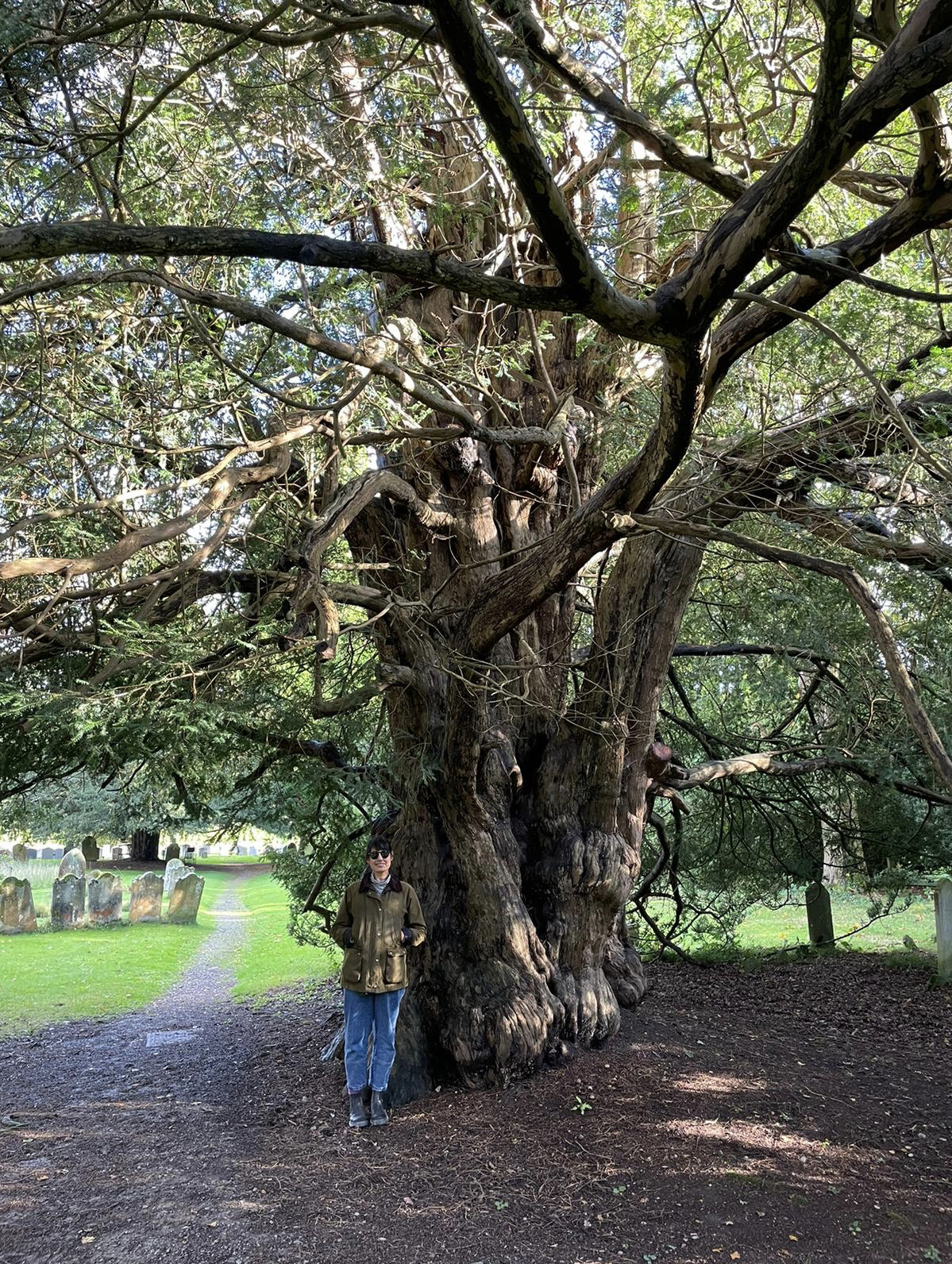
Figure 1.
The Slaugham Yew – with author for scale. All photos by the author.
Cook was born in London Road, Southwark but, when she was around nine years old, her father Joseph, a brazier, moved the family to a farm near St Leonard’s Forest in West Sussex – a formative time in which, Cook writes, ‘the woods and forests became [her] tutors’.2 Another major influence on her writing at this time was her mother, who encouraged her to write but died when Cook was fifteen, just before the family returned to London – a loss which inspired the elegiac poem that made Cook famous in the 1840s, ‘The Old Arm-Chair’.3 She published her first collection, Lays of a Wild Harp, in 1835, followed by Melaia and other Poems in 1838 and New Echoes and other Poems in 1864, in the meantime writing and editing her weekly miscellany, Eliza Cook’s Journal, from 1849 to 1854, a periodical which reflects Cook’s Chartist politics in its aim to aid ‘the gigantic struggle for intellectual elevation now going on’.4 The work of scholars such as Alexis Easley and Fabienne Moine reclaims this radical reputation, as well as celebrating Cook’s resourcefulness as a working-class woman who used ‘opportunities that arose with the formation of new publishing media in order to establish [herself] in a male dominated literary marketplace’ and her personal ‘iconoclasm’, especially in living as ‘very much an out lesbian’ in the celebrity culture of the 1840s.5 Though she retired from public life in the 1860s due to declining health, living on a civil-list pension with her nephew at 23 Thornton Hill, Wimbledon until her death in 1889, collected editions of her works continued to appear in the 1870s and 1880s – an impressive literary lifespan. She is buried in Gap Road Cemetery, Wimbledon, though the gravestone is no longer identifiable – it is thought to have fallen over, obscuring her name.6 The fate of Cook’s gravestone seems symbolic of the obscurity into which her work has fallen since its mid-nineteenth century heyday – poignantly recalling her tribute to the poet Thomas Hood – ‘In Life he dearly won his bread / In Death, he was not worth a stone’.7 If Cook’s grave site, too, is now obscure, I wondered where there might still be a site of physical connection to this forgotten trailblazer.
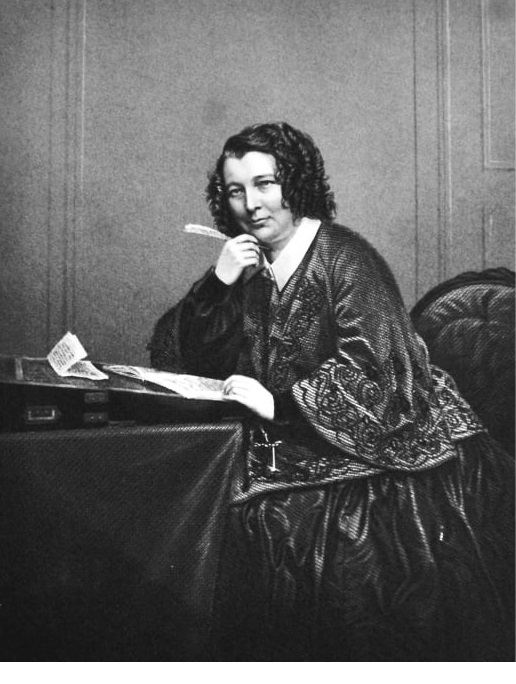
Figure 2.
Eliza Cook, forgotten trailblazer, c. 1859.
Source: The Drawing Room Portrait Gallery of Eminent Personages, 1859 (London: John Tallis, 1859); engraved by D.J. Pound.
The answer, predictably for this project, was arboreal. I started with Cook’s collections of poetry, which contain at least a hundred poems centring or featuring trees in a multitude of ways: they are celebrated literally for their beauty, as in ‘The Bonnie, Green Bough’ or their utility, as in ‘The Forest Trees’; they are lauded for their anti-materialist forms of value, as in ‘They All Belong to Me’; employed for their folkloric and symbolic associations , as in ‘The Willow Tree’; and used as analogies for human relationships, as in ‘Song of the Winter Tree’.8 Several poems about trees even make direct reference to Cook’s childhood experiences in West Sussex, such as ‘The Green Hill-Side’, in which the speaker is a ‘town-born child’ who moves to the countryside, gaining ‘all [her] childish soul had ever hoped to find’ in that ‘distant sylvan land’.9 But the poems, however apparently biographical, offered little indication of a precise location, and even the limited section of St Leonard’s Forest which is still open to the public today measures 714 acres.
Finally, with the help of Maggie Weir-Wilson, a local historian of Horsham, I found an article in Cook’s Journal from July 1852 entitled ‘Our First Sweetheart’, in which Cook, ill and prompted by her doctor to take ‘a decided change of air’, visits her ‘first rural home, in one of the wildest parts of Sussex’ and gives a description of the house and surrounding area.10 Very few of the locations she mentions – such as ‘Miller’s Brook’ and ‘Dives’s Farm’ – are traceable, not appearing on maps of the time.11 However, archivists at the West Sussex records office concluded from her references to ‘The Chequers’ pub and ‘the glorious old yew’ in the churchyard with a ‘gothic porch’ that Cook was likely describing the village of Slaugham.12 The churchyard in question is that of St Mary’s, and the yew, a designated Ancient Tree, is known by tree-enthusiasts simply as the Slaugham Yew.13 With thanks to a network of dedicated scholars and archivists, funding from the CHASE consortium, Birkbeck’s Harkness Prize, and the conveyance and generosity of my partner, I planned a trip to Cook’s ‘glorious old yew’.14
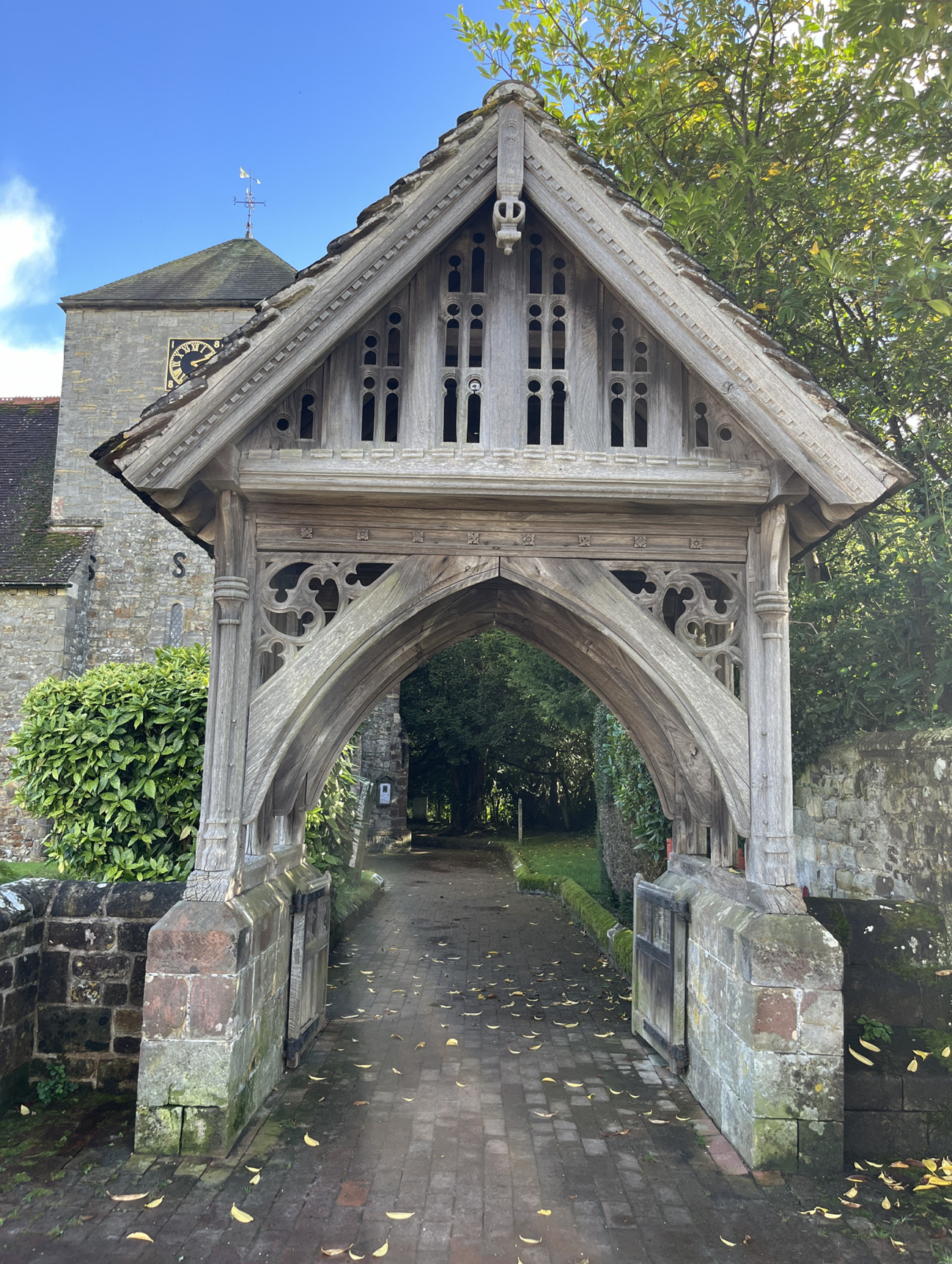
Figure 3.
The tell-tale porch: gothic entrance at St Mary’s Church, Slaugham.
The fact that a yew (Taxus baccata) was the lynchpin in my intertemporal Cook relic-hunt is fitting, given the tree’s associations with death, time and immortality, explanations for which are as various as its long life, its fatal toxicity if eaten, its sacred status in Druidic rituals and Celtic beliefs, and the fact that many yews were planted in churchyards (or many churches planted near ancient yews, depending on who you believe).15 More famous nineteenth- century examples of poetry about yews, such as William Wordsworth’s ‘Yew-Trees’ (1815) and Alfred, Lord Tennyson’s ‘In Memoriam A.H.H’ (1864), make use of this deathly-yet-immortal reputation to point out the difference between human and tree timescales. Wordsworth’s poem about the ‘fraternal four’ at Borrowdale is awestruck, describing the yew as ‘a living thing / Produced too slowly ever to decay’; Tennyson’s is more envious – the yew ‘net[s] the dreamless head’ of the elegiac subject, indifferent to ‘the little lives of men’ and the changes of time, which ‘touch not [its] thousand years of gloom’.16 Cook’s poetic references to yews are similarly grave, literally and metaphorically – in all but one example, where she praises the ‘tough and springy yew’ which was made into bows for the Battle of Agincourt, ‘the yew tree’s shade’ is entirely a site of gloom and death.17
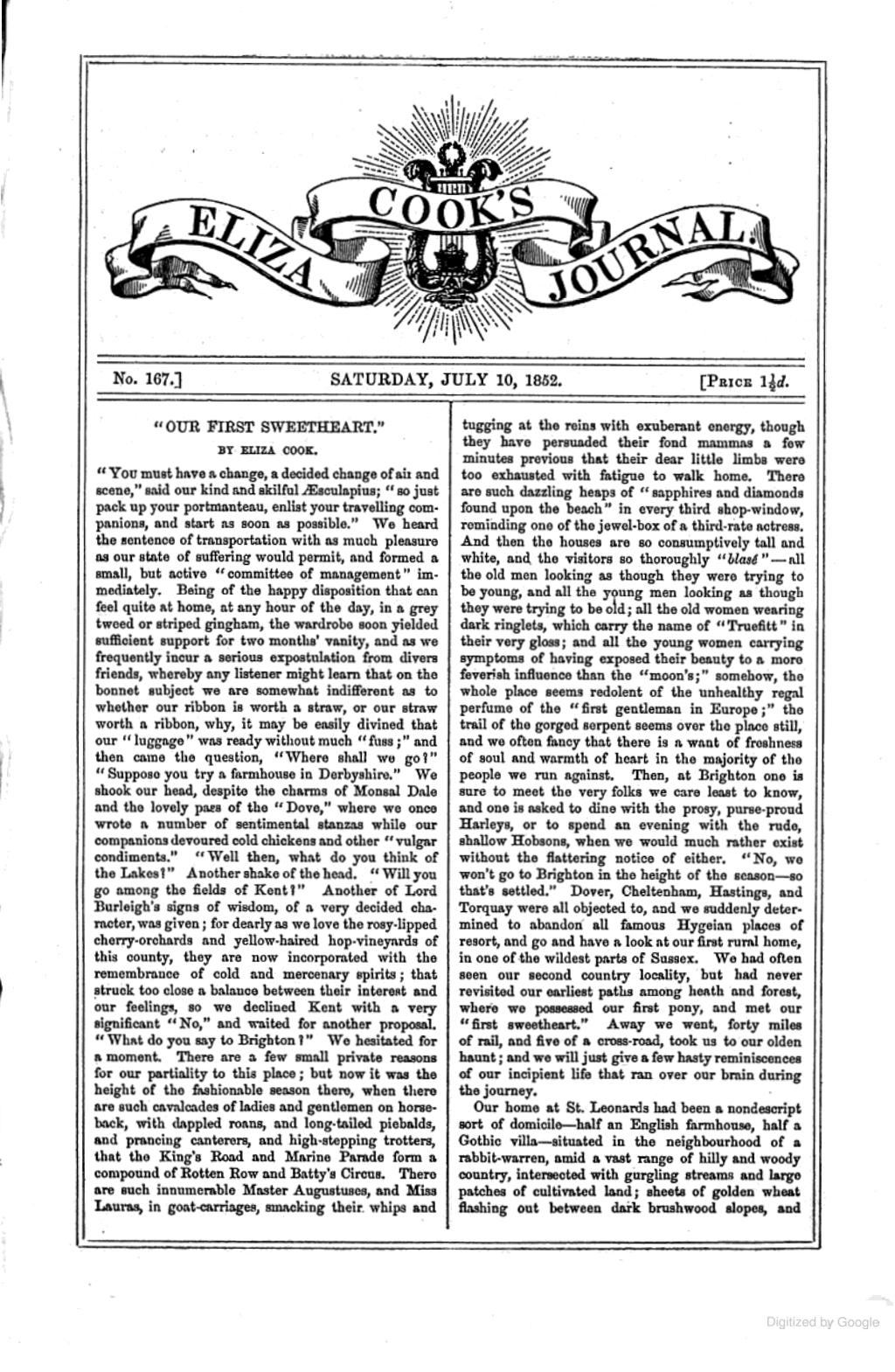
Figure 4.
‘Our First Sweetheart’ in Eliza Cook’s Journal, 10 July 1852.
Source: Google Books.
In ‘Our First Sweetheart’, the 1852 article that brought me to the Slaugham Yew, Cook’s description of the yew falls somewhere between Wordsworth’s and Tennyson’s: a site of intertemporal meditation, the tree’s seeming agelessness evokes former happy times as it contrasts them painfully with present realities. Revisiting the churchyard in the article, she finds herself looking at the tree and ‘dreamily musing on days gone by’ – in particular, as the title suggests, remembering her early ‘sweetheart’ Ben Hewitt, a ‘kind, manly six-feet-high’ local boy who paid the eight-year-old Cook a ‘most devoted lover-like attention’. 18 She recalls resting under the yew with Ben in the summers of her childhood, noting that, at the time of her re-visit, the tree is as ‘grand and gloomy as ever’ and ‘not a tinge less beautiful’.19 In 1852, though, the yew’s unchanged beauty also highlights sad change for the humans who used to sit in its shade. Cook’s illness means that her visit only offers ‘as much pleasure as our state of suffering would permit’; more tragically, she discovers from the Hewitt family grave that Ben’s ‘rest’ is now eternal – in fact, his entire family, including the sister he returned from America to nurse, has died of tuberculosis, followed six weeks later by Ben himself.20 The article concludes with a juxtaposition of past and present that almost amounts to an overlap, a haunting – ‘we saw him standing before us in his holiday suit,— tall, handsome, active and intelligent; and then we looked down and saw the pile of green sward speckled with daisies’. 21
Cook was in her mid-thirties when she wrote this article, and this period marked the beginning of a long decline in her health. The ways in which nature both offers and withholds solace are explored elsewhere in Cook’s writing, such as the poem ‘Not as I Used to Do’, a further reflection on infirmity published in an 1861 collection. In it, the speaker finds herself still ‘noting God’s glory’ in ‘the lime tree flinging / its beautiful green arms out’ but cannot love nature ‘as [she] used to do’ because ‘worn and weary / With waiting for health and rest’, she can ‘no longer wander / Through woodlands loved and dear’.22 Far from the stereotypical lone masculine wanderer of Romantic poetry, the speaker in Cook’s poem has lived, aged and lost her vigour amid the natural world, which has changed her attitude to, and her mobility within it. When I found out about the Slaugham Yew, I was only a year older than Cook was when she revisited it and, strangely, it also marked a period in my life which was characterised by mysterious ongoing illness and unexpected change. Six months later, having been diagnosed with relapsing-remitting multiple sclerosis, my woodland wandering, like hers, faces an unpredictable future. Cook’s article, reflecting in her mid-thirties on what would prove to be a long decline in her health, spoke to my dawning recognition of a changed and changing life last year; now, my presence under the same tree at the same juncture presents an uncanny parallel.
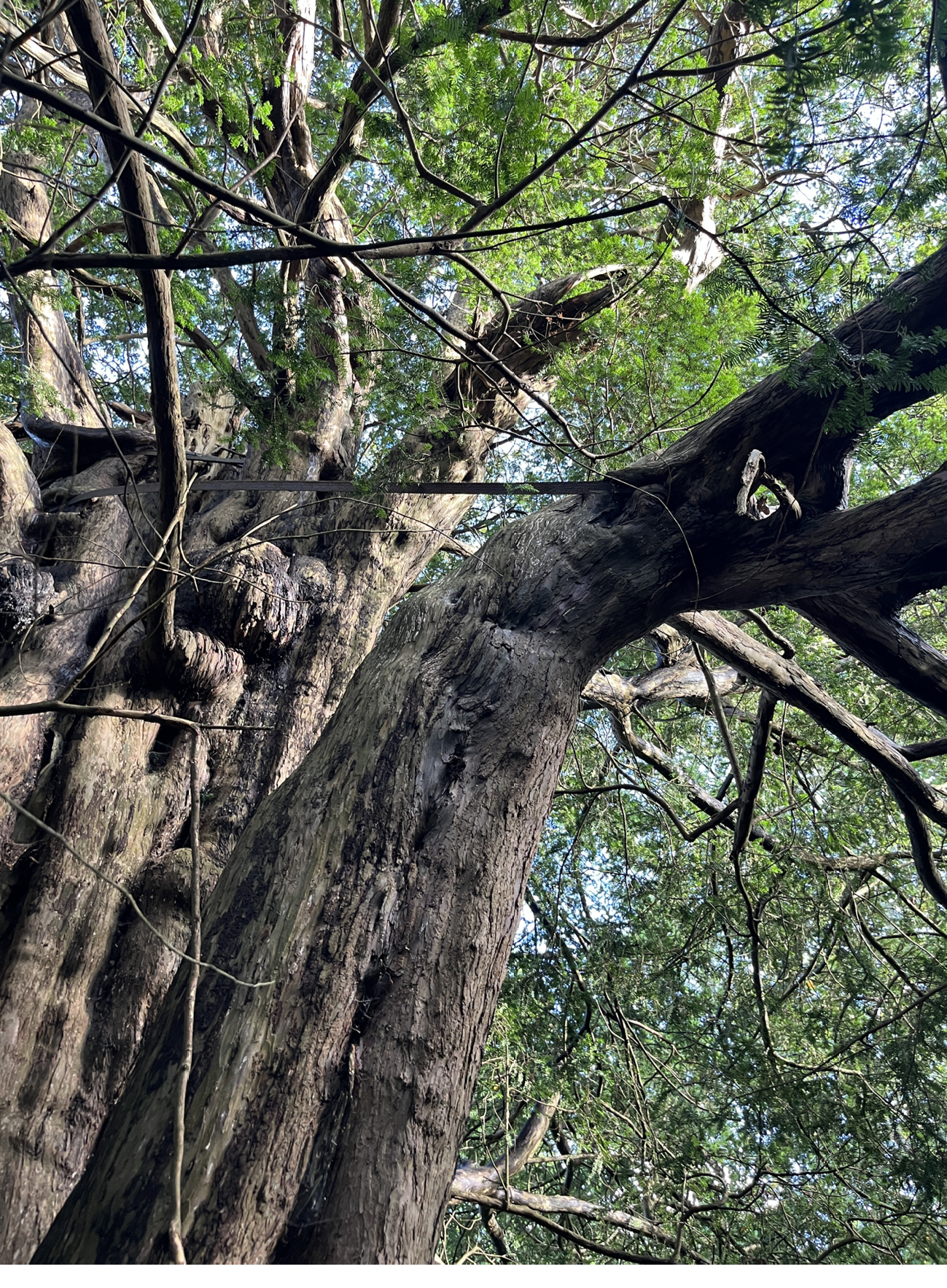
Figure 5.
We all need support – Slaugham Yew with metal reinforcements in upper branches.
Standing in the churchyard at St Mary’s, I marvelled that, though the Hewitt family stone was long since eroded or removed, the yew which had stood over Cook as a child, and again as a grown woman, now towered over me. It is hard for arboriculturists precisely to tell the age of a yew due to its tendency to hollow out from the centre, erasing the evidence of tree-rings, so that felling it reveals only an absence; in this sense, it is a symbol both of timelessness and inevitable decay, a metaphorical bridge and a physical link between Cook’s world and my own. But, noticing the metal supports keeping its upper branches in balance, I recognised the Slaugham Yew not just as a vessel for thinking about the past, but as a creature in its own right, which, like the humans who have stood beneath it, is just as vulnerable to disease and harm as it is aided by support and care. Deemed very much still ‘alive’ by the Woodland Trust’s Ancient Tree Inventory, the Slaugham Yew is an Ancient Tree and a Tree of National Special Interest, designations related to its size, age, location and historical or cultural importance which give it some protection, though of limited legal extent. Later, from the records of the Ancient Yew Group, I found out that the tree is female; and, while I hope it never comes to this, I liked the thought that I could come to its aid, making a case for preserving the tree and the memory of Eliza Cook in an act of interspecies, intertemporal sorority. Such an intervention in the fate of one tree is hardly reparation for the destruction wrought by human acquisitiveness, but a view of humans and non-humans as interconnected beings is a step in the right direction in an environment of anthropogenic hostility like our own. The poem I wrote in response to the site attempts to capture this conflicted impulse, cognisant of human culpability and the tree’s alterity, and founded in a recognition of both difference and interconnection only made possible by the survival of both tree and text. It alludes to Cook’s article and to the tree’s botanical realities, questioning where a lyric speaker stands, literally and metaphorically, in relation to such an entity.
Shani Cadwallender is a poet, educator, writer and creative-critical Ph.D. researcher in the arboreal humanities at Birkbeck. A working-class, queer, disabled, neurodivergent, mixed-race woman, she includes these facts not because she subscribes to identitarian categories, but because real lives are intersectional. You can find her work in Propel Magazine and at by-words.com
Email: shani.cadwallender@googlemail.com
1 For an overview of recent scholarly works exploring this idea, see W. Parkins and P. Adkins, ‘Introduction: Victorian ecology and the Anthropocene’, 19: Interdisciplinary Studies in the Long Nineteenth Century 26. https://doi.org/10.16995/ntn.818
2 Eliza Cook, ‘Preface to the new edition’, The Poetical Works of Eliza Cook (1853), p. xiii.
3 ‘Cook, Eliza’, Oxford Dictionary of National Biography: https://doi.org/10.1093/ref:odnb/6135 (accessed 28 June 2024).
4 Eliza Cook, ‘A word to my readers’, Eliza Cook’s Journal 1 (1) (5 May 1849), p. 1
5 Alexis Easley, ‘Constructing the mass-market woman reader and writer: Eliza Cook and the Weekly Dispatch, 1836–1850’, in Alexis Easley, Clare Gill and Beth Rodgers (eds), Women, Periodicals and Print Culture in Britain, 1830s–1900s: The Victorian Period (Edinburgh University Press: Edinburgh, 2019; online edition, Edinburgh Scholarship Online, 23 Jan. 2020); Podcast: ‘Eliza Cook and The Old Armchair’, https://libguides.stthomas.edu/profpodcast/transcripts/alexis-easley-eliza-cook-and-the-old-armchair
6 For this discovery, my thanks go to Professor Alexis Easley, who later confirmed it, and to Mary Ann Turnbull, who deals with graveyard enquiries at St Mary’s Church, Wimbledon. Mary Ann let me know that Cook was not buried at St Mary’s, but in the newer cemetery at Gap Road – a location recorded, misleadingly, as ‘in the parish’. Not only that, but Mary Ann took her grandson on a grave-finding expedition and located the plot; there, she found a stone lying face down next to that of Cook’s nephew and suggests this might be Eliza Cook’s (though I have not yet, as Mary Ann suggested, made the pilgrimage with enough ‘hunky mates’ to help me lift it).
7 The Poetical Works of Eliza Cook (Frederick Warne & Co, London, 1870), pp. 37–38. This poem was written at Kensal Green Cemetery, part of a campaign to erect a memorial for the poet Thomas Hood.
8 These poems can all be found in Eliza Cook, The Poetical Works of Eliza Cook (1853).
9 Eliza Cook, Poems (Routledge, 1861), p. 523.
10 Eliza Cook, ‘Our First Sweetheart’, Eliza Cook’s Journal, Volumes 7–8, no. 167 (10 July 1852), p. 161.
11 Ibid., p. 162.
12 Ibid., p. 163.
13 https://ati.woodlandtrust.org.uk/tree-search/tree?treeid=4409&from=3523&v=2666890&ml=map&z=15&nwLat=51.044755787050505&nwLng=-0.23994423939208254&seLat=51.03161396162007&seLng=-0.17814614368895754#/ (accessed 31 Oct. 2024).
14 Eliza Cook, ‘Our First Sweetheart, p. 163.
15 https://www.woodlandtrust.org.uk/trees-woods-and-wildlife/british-trees/a-z-of-british-trees/yew/#:~:text=Mythology%20and%20symbolism&text=Yew%20trees%20were%20used%20as,were%20made%20of%20yew%20staves (accessed 15 Oct. 2024).
16 William Wordsworth, ‘Yew Trees’, The Major Works ed. by Stephen Gill (Oxford University Press, 2008), p. 334; Alfred, Lord Tennyson, In Memoriam A.H.H., ed. Erik Gray (W.W. Norton & Co., London, 2004), p. 7.
17 Eliza Cook, ‘The Bow’, The Poetical Works of Eliza Cook (Frederick Warne & Co., London, 1870).
18 Eliza Cook, ‘Our First Sweetheart’, p. 163.
19 Ibid., p. 163.
20 Ibid.
21 Ibid.
22 Eliza Cook, Poems (Routledge, 1861), p. 402.