
Melanie Ford and Eric A. MacDonald
Where on Earth
are the Moon Trees?
PLANT PERSPECTIVES 2/2 - 2025: 409–434
doi: 10.3197/whppp.63876246815907
Open Access CC BY 4.0 © The Author
ABSTRACT
This essay describes the history of ‘Moon Trees’ – trees that were grown from seeds that accompanied the NASA Apollo 14 mission to the Moon in 1971. During the mid-1970s, Moon Tree seedlings were planted in communities across the United States as part of the nation’s bicentennial celebration. Here, I discuss how Moon Trees became symbols of pride in the scientific and technological advancements in the United States, and the various ways in which they have impacted the communities in which they were planted. I also chart the current efforts (including my own journey) to document and to tell their stories, and the ways in which such efforts emerge from the interweaving of technology and personal and collective memories.
KEYWORDS
Trees, Moon Trees, heritage trees, space exploration, Stuart Roosa, NASA, US National Forest Service, US Bicentennial, storytelling
 My Moon Tree Odyssey
Some children grow up on farms surrounded by open spaces, plants, and farm animals. Others grow up in the heart of bustling cities learning to navigate urban landscapes through subways and elevated public transportation systems. My childhood was shaped by a confluence of events in Huntsville, Alabama, a city in the US South that was the stage for important developments in the science of space exploration as well as the US Civil Rights Movement. My encounters with these seemingly disparate but consequential currents in twentieth-century history were supplemented by solitary explorations through Huntsville’s Maple Hill Cemetery. These formative experiences fostered my affinity for history, place and landscapes and shaped my thought processes as an adult. The memory recall and association collided when I re-discovered the Moon Tree in Athens, Georgia.
Growing up in Huntsville during the 1960s and 1970s, home to the Marshall Space Flight Center and the Redstone Arsenal, I was surrounded by children whose parents, like my father, worked for an entity associated with the space programme. Many of my high school friends followed in their parents’ footsteps. Huntsville’s civic centre is named for Wernher von Braun, a German-born scientist, who in 1942 launched the first rocket into space while still living in Germany and working for the German government. Following the end of World War Two, von Braun and his team of scientists fled Germany and surrendered themselves to the United States Army in 1945. Von Braun and his group of scientists were known as the ‘Operation Paperclip Scientists’ because their files were marked with paperclips.
In 1950, von Braun and his team were transferred to Huntsville, where they began developing rockets for the US space programme. Von Braun later remarked that Huntsville and its surrounding mountains reminded him of Wirsitz, Germany, his hometown.1 In Huntsville, von Braun and his team continued their advancements in space exploration, contributing to the success of the Apollo programme, which culminated in Apollo 11’s landing on the Moon in 1969. These events unfolded as I was beginning elementary school, growing up alongside the space programme as it matured and gained international recognition.
Many years later, my personal history with the space programme and my hometown – coupled with a sense of nostalgia – was reignited during the summer of 2020 in Athens, Georgia, where I now live, while taking a class entitled ‘Plants and Pollinators’ as part of my pursuit of a Master’s degree in landscape architecture. Our final class project involved assessing the pollinator-friendliness of a public facility. I selected the 120 Dougherty Street Government Building as I work in construction management, and this is the home of the Athens-Clarke County Building Inspections Department, an entity I am familiar with through work. While researching the history of the building for context to write into my report, I came across a scanned newspaper article detailing the dedication of a ‘Moon tree’ in 1976 (Figure 1). The excitement I felt at that moment was undeniable – it was as if my childhood and the present had collided, bringing back memories of growing up in Huntsville amidst the space programme’s breakthroughs.
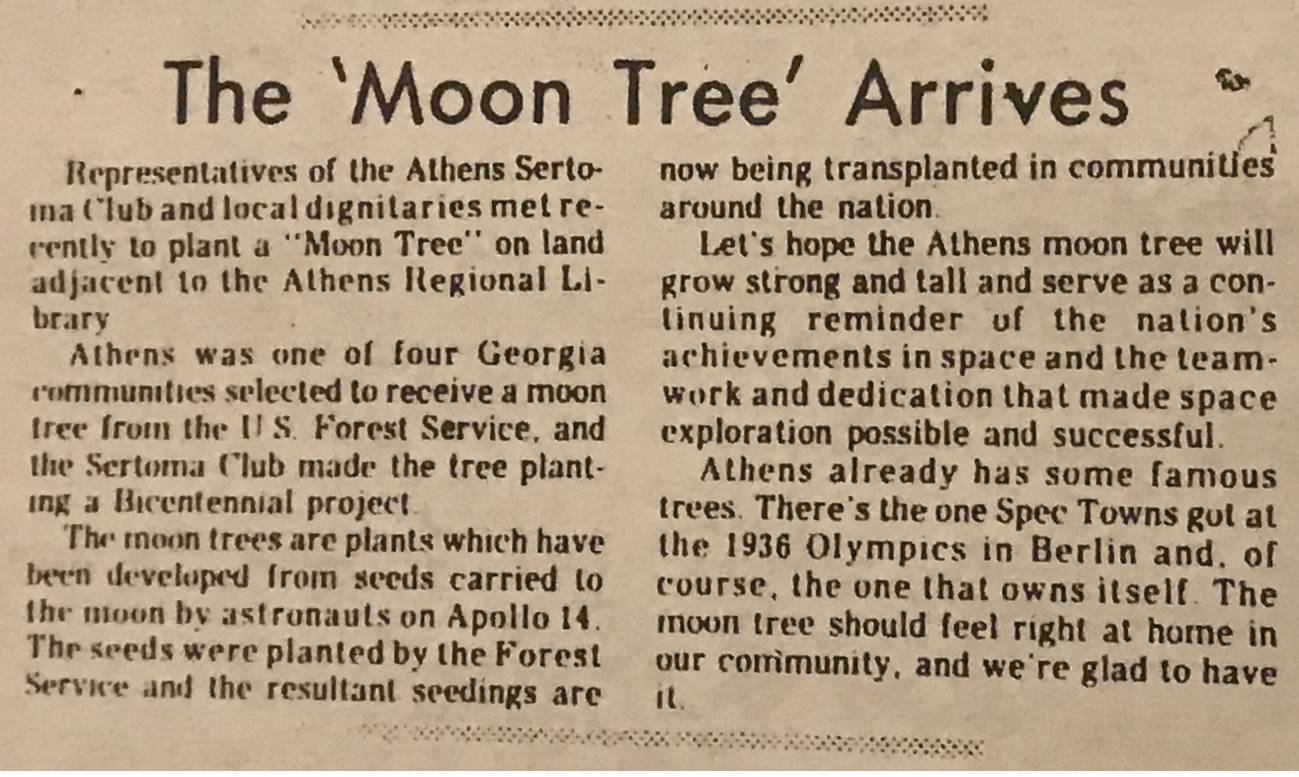
Figure 1.
Article published in the Athens Banner Herald, 16 May 1976 announcing the arrival of ‘the Moon Tree’ to Athens, Georgia.
Source: Athens Banner Herald
The newspaper clipping revealed that the tree at 120 Dougherty Street was grown from one of the seeds taken to the Moon during the Apollo 14 mission in 1971. When I returned to the site with this newly found insight, I found the tree, an unassuming Loblolly pine (Pinus taeda), quietly spreading its branches over a parking lot for the local planning and zoning commission (Figure 3). This discovery felt deeply personal, and the bond I felt with the tree was instant and powerful. It was a remarkable connection that drew on the history I had grown up with in Huntsville. The Moon Tree quickly became a symbol of this shared history. It struck me as sad that such a remarkable piece of history had remained largely unknown. My next thought was: ‘Why didn’t I know about this tree? Does anyone else know about it?’ I decided then that it needed to be recognised. I also became curious about the whole Moon Tree phenomenon. Where are all these trees located? Do they have meaning to the communities in which they are planted and have they somehow impacted the landscape that surrounds them? I embarked upon a research project to answer these questions.
A short history of Moon Trees
The story of the Moon Trees begins in 1971 with the United States Apollo 14 space exploration mission. The crew consisted of Mission Commander Alan Shepard, Command Module Pilot Stuart Roosa and Lunar Module Pilot Edgar Mitchell.2 Roosa, who had formerly worked for the United States Forest Service (USFS), was asked by his former employer to travel with 500 seeds from five tree species: loblolly pine (Pinus taeda), coast redwood (Sequoia sempervirens), sweet gum (Liquidambar styraciflua), Douglas fir (Psedudotsuga menziesii) and American sycamore (Platanus occidentalis). While no documentation has yet revealed why these five species were chosen, there is speculation that they may have been selected because they would grow across a large cross-section of the United States, particularly at the USFS research stations located in Gulfport, Mississippi and Placerville, California. Each astronaut is allowed to carry a personal item into space, although the item has to weigh less than two pounds and fit into a relatively small space. The items carried often reflect some accomplishment on Earth, some progress made in technology or societal advances. There is typically a symbolic tie between the astronaut’s history and the artefact, and this was the case with the seeds that Stuart Roosa (who had ties to the USFS) took.3 The USFS intended to study the seeds and growth patterns of their seedlings in hopes of determining how, or whether, space travel would have any impact on them.
Following Apollo 14’s successful mission to the Moon, the seeds were returned to NASA, who germinated some of the seeds and grew them as seedlings during a one-year experiment. NASA subsequently abandoned the project because the agency lacked suitable facilities to sustain the trees. They returned the remaining ungerminated seeds to the USFS, who successfully germinated and developed a significant number of the remaining seeds. Scientific experimentation with the seeds and seedlings began to conclude just as the United States Bicentennial Celebration was approaching in 1976. The USFS decided to disseminate these seedlings, which had become known within the agency as ‘Moon Trees’ to differentiate them from other experimental plantings, to various states for planting in local communities. Newspaper articles that were written about the planting of these seedlings suggest they were planted as a tangible symbol of the bicentennial celebration, and that they were intended to instil pride in the nation’s accomplishments, particularly as related to space exploration.
Community celebrations were held across the United States in honour of these trees. Public officials spoke, community colour guards presented the flag, community high schools performed patriotic songs and everyone present had an opportunity to revel in the celebration. Media documented the planting with photography and afforded everyone an opportunity to learn of the momentous occasion. While some trees found their way to obscure or unusual locations, most were planted on the grounds of a public institution, such as a government building, a public school or university or a building that had some association with the forest service. In some instances, plaques were placed next to the trees to identify and commemorate them.
Through the years, many of the Moon Trees and their known locations were slowly forgotten. Physical signs and other markers identifying their national significance disappeared. In other instances, the plaques became just another part of the ‘landscaping,’ often overlooked and unnoticed. Some deteriorated or were mowed down. From a physiological and visual standpoint, the Moon Trees themselves looked like any other local example of their species. They became ‘just’ trees. Years passed and many of these Moon Trees were forgotten entirely.
In 1996 one of these trees ‘resurfaced’, sparking what would eventually become a nationwide quest to recover their stories. A third-grade teacher, Joan Goble, was working with her students on a project about trees when one student mentioned that she knew of a Moon Tree near her Girl Scout camp, Camp Koch near Cannelton, Indiana. Curious to learn more, Goble visited the camp and discovered a sign verifying the student’s story. Subsequently, she emailed NASA to learn more about the tree and its significance.4 Goble was directed to David Williams, NASA Space Science Data Archivist, who also was unfamiliar with Moon Trees. However, this one email prompted him to research the NASA archives, where he eventually discovered newspaper clippings, letters and memos that attested to the trees’ existence. Through discussions with USFS employees, Williams learned that no one possessed formal records or documentation regarding the seedlings’ distribution and planting locations. Shortly thereafter, intrigued by the story of the Moon Tree and eager to learn more, Williams created a web page dedicated to Moon Trees, inviting people to submit images and information about them, including their whereabouts and their history.
Since Williams’ creation of the web page, many people have written to Williams, eager to share their images and stories of the Moon Tree in their community. Several communities never ‘lost’ their Moon Tree, and have honoured them throughout the years with events held in their midst. Some communities have used their Moon Tree to foster education about space exploration and forestry, and many regularly host educational programmes that showcase their tree. However, there are still potentially many Moon Trees that have not yet resurfaced from the pages of history and are waiting quietly for rediscovery. The following case studies shed some light on the varied lives of the Moon Trees. They show how the individual lives of the trees have become intertwined with the lives of individual people and communities in ways that are sometimes revealed only through the passage of time.
Athens, Georgia
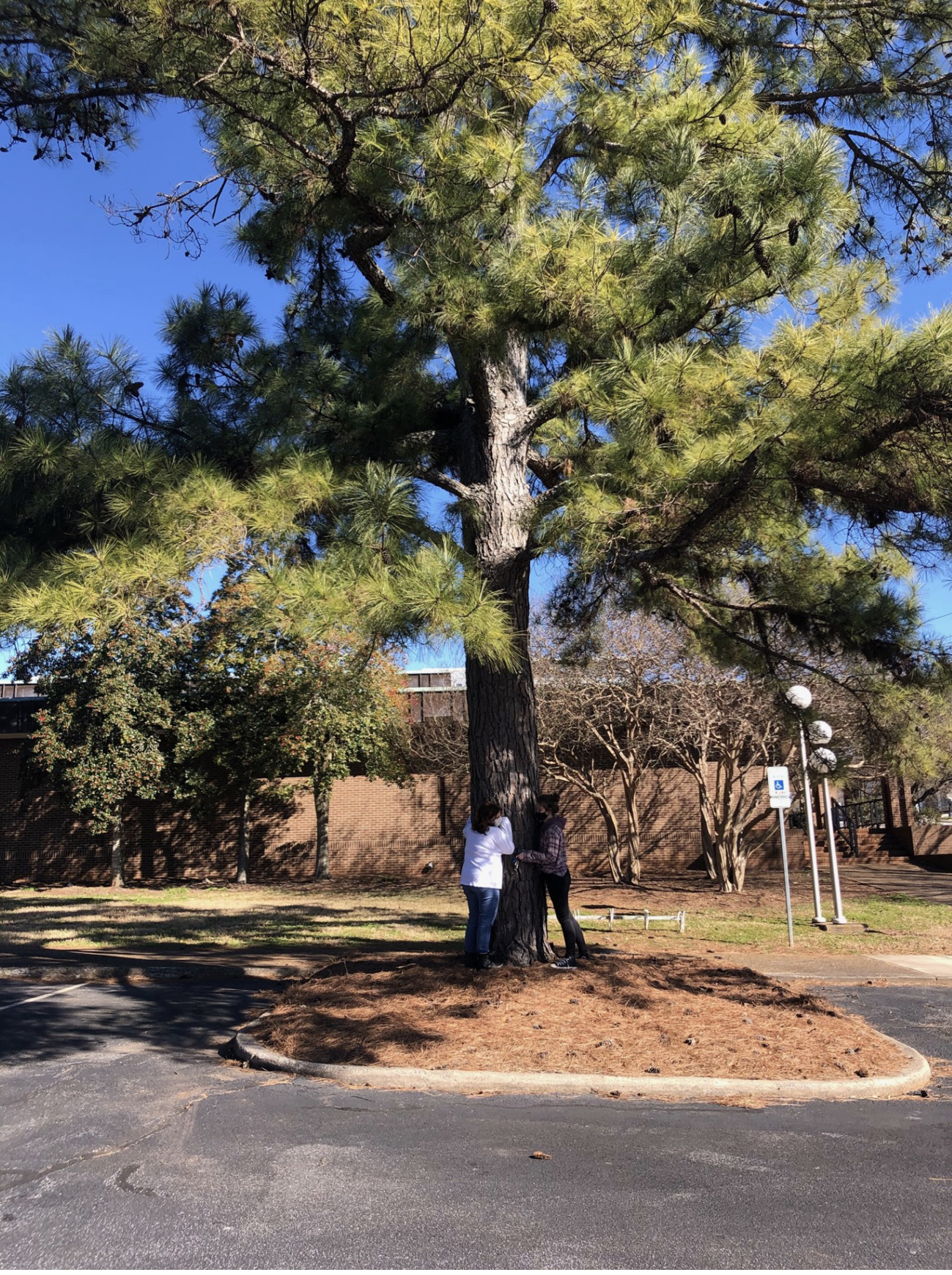
Figure 2.
The Moon Tree in Athens, Georgia, planted in 1976 (with no identifying sign) when I discovered it in 2020.
Source: Melanie J. Ford.
This tree launched the beginning of my Moon Tree odyssey. The morning after I discovered the newspaper clipping that recorded the tree’s dedication ceremony in 1976, I contacted the Athens-Clarke County Grounds Manager, Andrew Saunders. I inquired if he was familiar with the Moon Tree and whether I could donate funds to erect a plaque to broaden public awareness of this historic landscape feature. Andrew responded apprehensively. He said he was aware of the tree and, that as the Grounds Manager, he could erect a sign, but he cautioned me that the tree was likely to be reduced to a pile of mulch in the near future. I was appalled and stated that I would make sure that didn’t happen. I asked why the tree’s days were numbered. Andrew said that discussions were currently ongoing to sell the building and its grounds as part of a large redevelopment project that would involve several blocks in the area. Andrew directed me to contact the local mayor if I wished to discuss the issue.
I immediately placed a call to a friend who was also a former county commissioner. She was unfamiliar with the Moon Tree but was delighted to hear of such a treasure in our midst and eagerly contacted the mayor. She called me back to tell me that she was very disappointed in the mayor’s response, which was that we should plan to gather seeds from the tree and be prepared to plant the ‘son’ of the Moon Tree. While I was aware that the mayor’s response was likely based upon the idea that we have another famous tree in Athens, the Tree that Owns Itself, that is a ‘son’ of the original tree resulting from the original tree being destroyed by lightning, the response was not what I wanted to hear. Considering that the Moon Tree was not only alive, but also thriving and healthy, it seemed a shame not to protect it in its current location. So, as I hung up the phone, I simultaneously walked into a work meeting, grumbling loudly to one of my co-workers about the issue. My uttering the words ‘Moon Tree’ piqued the interest of those already present and they asked for an explanation. I finished the story with, ‘so I just need to find someone who is working on that project so that I can make them aware of the existence of the Moon Tree’. At that point, Buck Bacon, the civil engineer in the room, raised his hand. He admitted that he was the site designer for the master plan that was currently underway for the proposed development. I retorted, ‘Well, you just need to go ahead and draw yourself a courtyard around my Moon Tree!’ He laughed and said that he would include it in the agenda for the next meeting.
Meanwhile, I continued to delve into the history of the Moon Tree. I learned from the former Director of the Building Inspection Department, Phillip Seagraves, that the Athens Sertoma Club, an organisation dedicated to improving the quality of life for those at risk or impacted by hearing loss through education and support,5 had been the group that had requested the seedling from the Forestry Commission for planting in Athens. The Athens-Clarke County Government Building was formerly home to the Athens-Clarke County Public Library, and this was the facility originally selected for planting the Moon Tree. Later, as a result of the tree having been planted at this location, a fragrance garden was planted on the library grounds to allow those who were visually impaired to enjoy a garden. A sculpture was also installed in this garden entitled ‘Shoot for the Moon’ (Figure 3), which was erected to continue the space theme across the building campus.6 The overarching theme of inspiration, education and inclusivity permeated the built environment at this location.
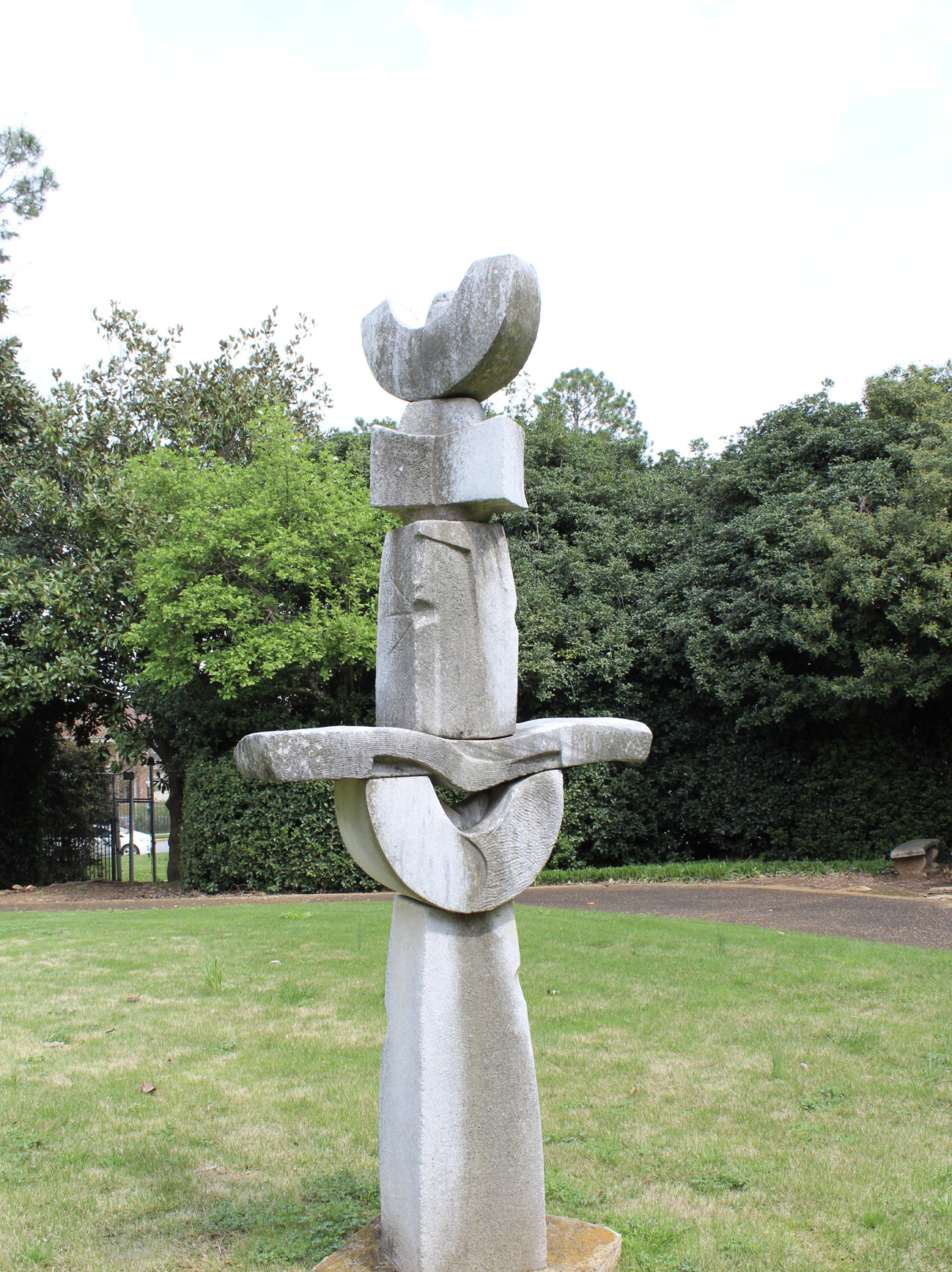
Figure 3.
‘Shoot for the Moon’ sculpture erected in the fragrance garden of the Athens-Clarke County Government Building, formerly the Athens-Clarke County Library.
Source: Melanie J. Ford.
As the weeks following my conversation with Buck stretched out, he was unable to provide any real updates about the future of the tree. Despite numerous phone calls to the Athens-Clarke County Grounds Department for an update on the plaque, they never seemed to show any progress. I feared that I was being pacified and that I would soon see construction fencing appearing around the site. I grew concerned and contacted the local newspaper, the Athens-Banner Herald. I shared the original 1976 article that they had published identifying the Moon Tree and requested that they publicise the situation. They were happy to oblige with an article that appeared in the paper within the week, and thereafter I immediately began fielding phone calls from the local historical society and from interested citizens. The historical society offered to host a re-dedication when the new sign was installed, and they agreed to keep me informed of their plans.
Eventually, with additional clamour created by various citizens, the sign was produced and installed. A re-dedication event was held (Figures 4 and 5) and I spoke about the Moon Tree and its place in the history of the nation and our community. David Williams, NASA’s archivist, and Rosemary Roosa, the astronaut Stuart Roosa’s daughter, participated in a Zoom meeting following the re-dedication event. Overall, it was a very successful ‘saving of the Athens Moon Tree’. The community created sufficient hype around its Moon Tree such that it will not soon be forgotten again.
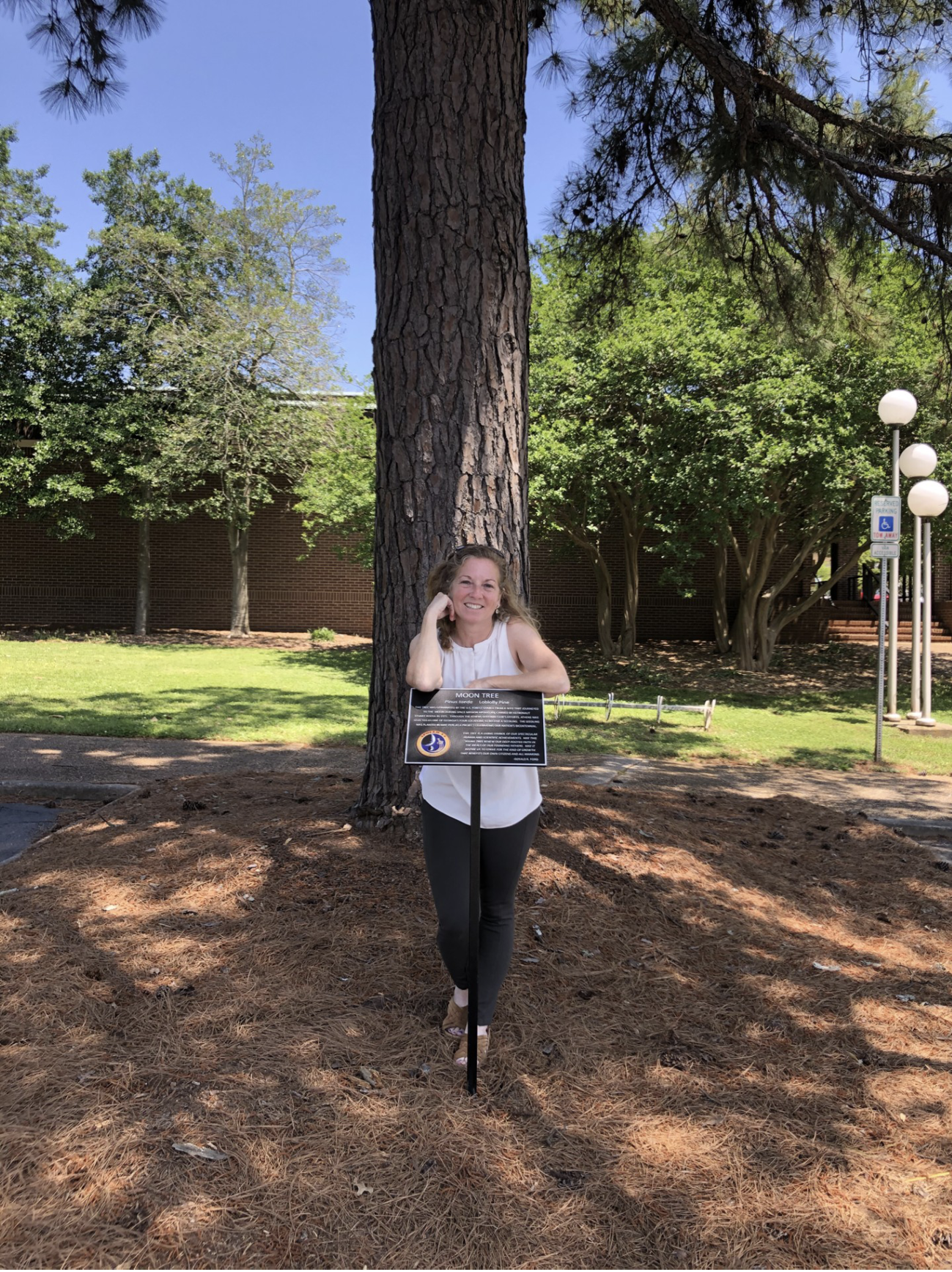
Figure 4.
The Moon Tree located at the Athens-Clarke County Government Building with the new sign installed during the re-dedication in 2021, the 50th anniversary of the Apollo 14 mission.
Source: Jessica L. Ford.
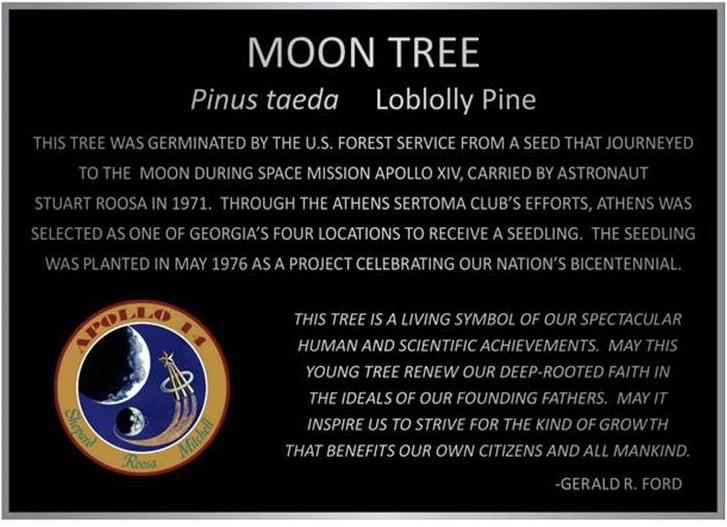
Figure 5.
The commemorative sign installed during the re-dedication of the Moon Tree in Athens, Georgia, in 2021.
Source: Athens-Clarke County Landscape Management
The rediscovery of the Athens Moon Tree inspired me to fight for its survival. It seems to have channelled several personal passions: community, history, my childhood memories, solving mysteries. Learning that we had been granted the opportunity to care for such a seemingly important part of our country’s history inspired me to make every effort to protect it. It also sparked my desire to learn the entire history of the Moon Trees, which led to a quest aimed at locating the remaining three forgotten Moon Trees in the state of Georgia. So far, my research adventures have led to the successful location of two of the missing Moon Trees: a loblolly pine located in Macon, Georgia, at the Georgia Forestry Commission’s headquarters; and a sycamore planted on the State Capitol Grounds in Atlanta, Georgia. The details of one of these Moon Tree discoveries, the Moon Tree in Macon, Georgia, is the first of my two favourite Moon Tree stories that follow.
Macon, Georgia
I learned from reading the article, ‘The “Moon Tree” Arrives,’ published in the Athens Banner Herald on 16 May 1976, that Moon Trees had been planted at four locations in the state of Georgia.7 I began an internet search for the locations of the other three, but the only other Moon Tree in Georgia that appeared in the search results was located in Waycross. I subsequently learned that just about anyone who has ever heard the words ‘Moon Tree planted in Georgia’ has likely heard of the Moon Tree located in Waycross. It has been described as ‘the only Moon Tree in Georgia’ for a long time (Figure 6). Even today, this is likely to be the case, since the rediscovery of the others is relatively recent. The Waycross specimen is the only Moon Tree in Georgia that was identified with an interpretive sign acknowledging its significance, and this likely is the reason why it is the one Moon Tree in Georgia that did not get lost to history. ‘Two known, two to rediscover’, I thought at the time, as I was then unaware that the Waycross tree is an outlier and not one of the original bicentennial four.
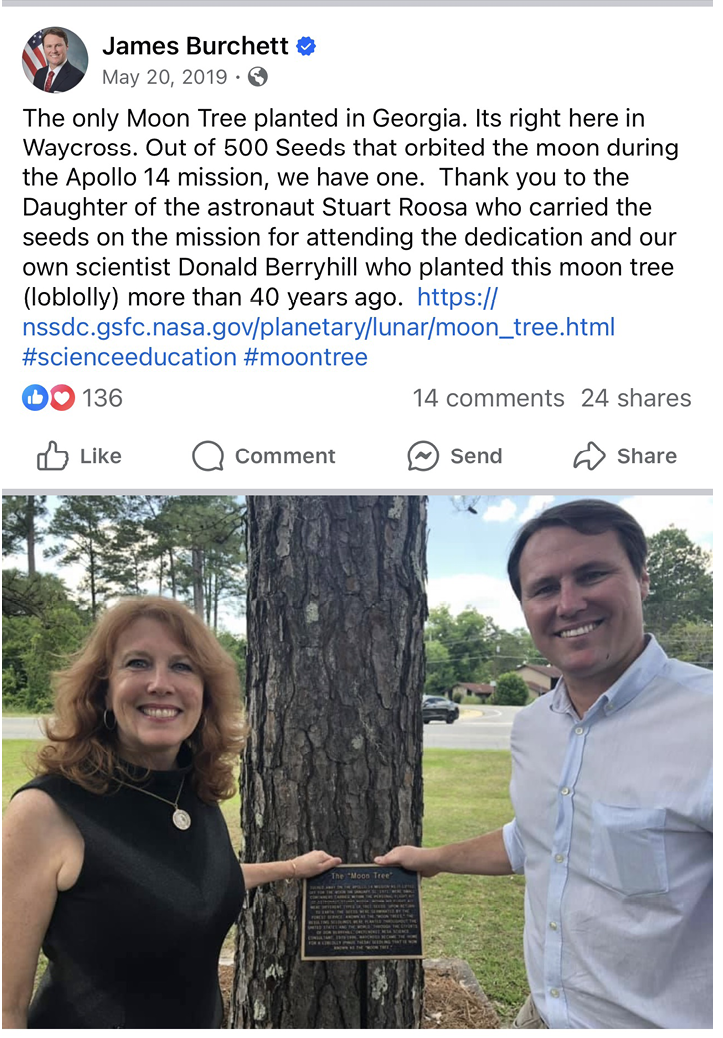
Figure 6.
Facebook post by James Burchett, Georgia House District Representative, on May 20, 2019, erroneously identifying the Waycross Moon Tree as the only Moon Tree planted in Georgia.
Source: James Burchett Facebook page, screenshot by Melanie J. Ford.
My ability to research historic periodicals was limited as I had no idea in which cities to search. However, I discovered a national periodical entitled the Bicentennial Times that had documented planned events in each state for the bicentennial celebrations. Unfortunately, I found no mention of the Georgia Moon Trees in any articles that I was able to access. Fortunately, a chance encounter on a construction site tour of mass timber framing construction with the Director of the Georgia Forestry Commission, Tim Lowrimore, resulted in the eventual rediscovery and identification of the Moon Tree in Macon, Georgia. Lowrimore was unfamiliar with the Moon Trees. However, as I explained to him what they were, their significance and the US Forestry Commission’s role in their inception and dissemination, he became interested enough to assume the cause. Upon his return to his office, he asked one of his employees to search through the Georgia Forestry Commission’s archives for articles written in 1976. The employee, Aubrey Deane, located an article from a 1976 edition of Georgia Forestry Magazine that included an image of the planting and dedication of the Macon Moon Tree (Figure 7).
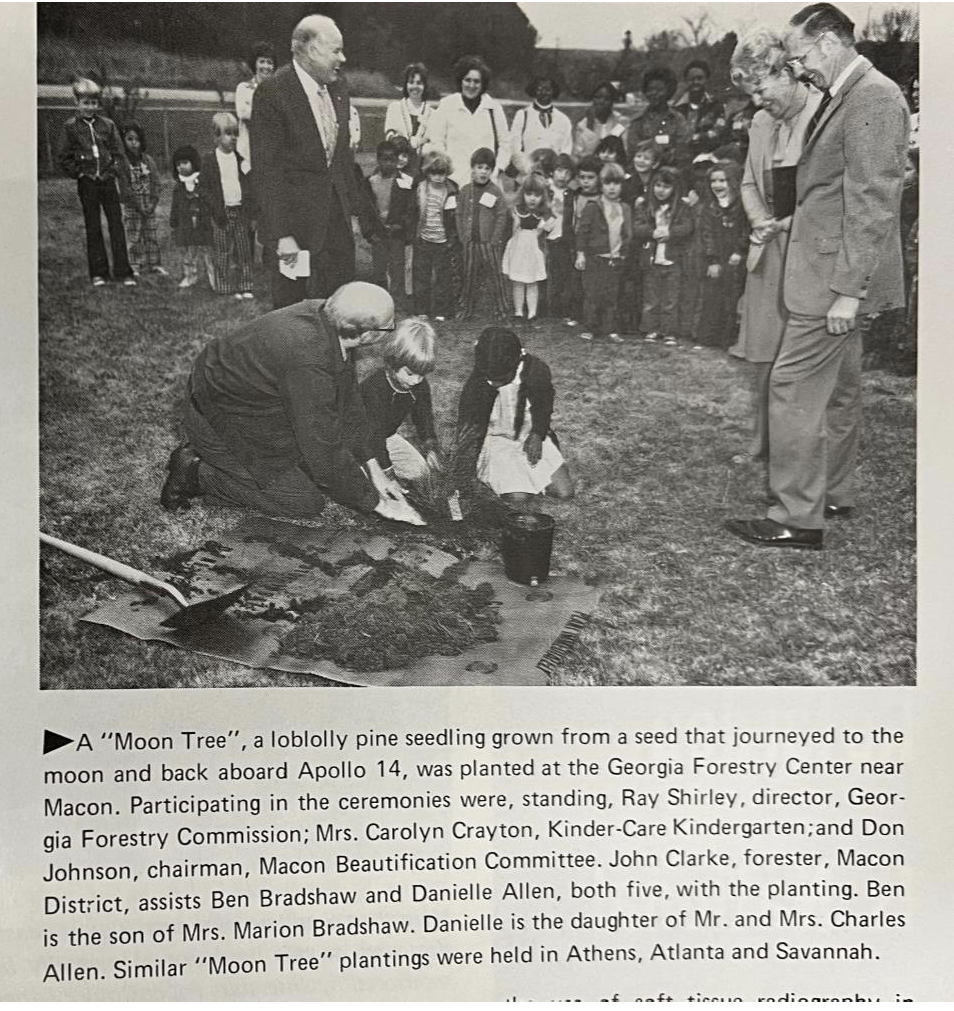
Figure 7.
Article from the Georgia Forestry Magazine showing the planting of the Moon tree in Macon, Georgia, in 1976. The two children shown in the photo are Ben Bradshaw and Danielle Allen.
Source: Georgia Forestry Commission.
The article discovered by Deane clearly identified the locations of Georgia’s four Bicentennial Moon Trees as Athens, Atlanta, Macon and Savannah. Waycross was conspicuously absent from the list. The article also provided the address of the Macon tree as the office of the Georgia Forestry Commission, Lowrimore’s own place of employment. I later learned from an employee at the facility that rumours had circulated some time ago about a ‘Moon Tree’ that had been planted on the site. However, the employee admitted that no one was familiar with it, nor did anyone have any idea where it might have been planted.
Lowrimore set about trying to identify the tree. His expertise as a forester proved beneficial, as he was able to identify the loblolly pines on the site and to determine which were in the potential fifty-year-old age range. He was not, however, able to determine positively which one was the Moon Tree. I visited the site and spent several hours exploring the grounds and came to the same determination as Lowrimore: there were only two trees that could possibly be the Moon Tree. My conclusion was based upon the size and species of the trees as well as their proximity to the roadways, as shown in the historic photograph. To identify conclusively the real Moon Tree, we needed an eyewitness to its planting.
The article itself mentioned several names: four of these were the adults in the photograph and two were five-year-old children who participated in the event and assisted with the planting of the tree. The only adult in the photograph still living is Carolyn Crayton, who is a long-time resident of Macon, Georgia. Ms Crayton, now in her nineties, was a pre-school teacher at Kinder-Care Kindergarten, and it was two of her students who were pictured in the photograph. I contacted Ms Crayton, and while she originally agreed to meet me to assist with the identification of the Moon Tree, she later recanted, unsure if she could identify the tree and concerned about providing inaccurate information.
Months went by, and a fortuitous encounter at a construction management conference afforded an introduction to Sam Macfie, a long-time resident of Macon. When I learned that he had lived in Macon his entire life, I showed him the image from the magazine, shared with him the tale of the Moon Trees and asked if he knew or recognised any of the children in the image. He did not, but throughout the course of the conference, he continued to search the internet for the whereabouts of the two children named in the article. When the main portion of the conference ended and everyone left for the construction jobsite tour, Sam said he was skipping the tour in favour of a trip to a house where he believed one of the now-grown children might live. He said he would return before the afternoon reception that followed the tour. I was surprised that this man, whom I had just met, was going to this extent to assist me in my research, but as a long-time Maconite, he was just as eager as I was to locate the child and excited to rediscover the tree.
While Sam’s efforts that day were not fruitful, only a couple of weeks later I received a phone call from him in which he excitedly shared that he had located Ben Bradshaw, the little boy from the image. He said he had not yet spoken to Ben but had met his wife. Following up on leads that he had obtained from his previous excursion, Sam had located where Ben lived, and when he knocked on Ben’s front door, his wife answered. Sam assured her that he was not selling anything. He asked whether the words ‘Moon Tree’ meant anything to her. She was very surprised, and at the same time very excited and said, ‘Are you kidding me?’ She then produced an electronic photograph on her cell phone of the image that I had shared with Sam from the Georgia Forestry Magazine. Hers was a photograph of the copy that Ben’s grandmother had kept on her refrigerator from the time it had appeared in the periodical until she passed away several years ago. Ben later told us that the paper copy was disintegrating when he removed it from her refrigerator, so he took a picture of it to document it before throwing away the original.
Following that day’s events, Sam and I both spoke to Ben on a three-way phone call and inquired about his memories of the Moon Tree. Only a few weeks later Sam also located Danielle Allen, the little girl also named in the article. Sam and I, thereafter, had a similar conversation with her. Ben and Danielle both commented on how the experience of that day had impacted their perception of space and inspired in them an affinity for space travel. Danielle commented that she had begged her mother to send her to Space Camp in Huntsville, Alabama, and Ben mentioned that he had developed an interest in astronomy stemming from that experience with the Moon Tree. They both mentioned how special they felt, beaming with pride at five years old, for having been selected to help plant this special tree.8
Despite all of this progress, the Moon Tree still had not been identified and was still essentially lost. While the number of potential candidates had been narrowed to two trees, there was no conclusive evidence to indicate which tree it was. Ben was eager to visit the site, having wondered often throughout the years just exactly where the tree had been planted. Although the original dedication article states quite plainly where the tree is planted, somehow Ben thought that it had been planted in the Ocmulgee Burial Grounds, which are located a short distance from the Georgia Forestry Commission headquarters facility.
I obtained permission from Tim Lowrimore to bring Ben onto the Georgia Forestry Commission Headquarters site, which is a gated, secure site. I took Ben first to the tree that I felt was most likely the correct tree based upon its proximity to the roadway, as well as the type and height of the fence line. I will add here that the profile of the roadway did not quite match up, but the fence line at the second tree didn’t make sense to me either. Ben wandered around the tree but said that it didn’t seem quite right to him. He didn’t recall walking up the slight hill. He also recalled a building beyond the tree, and this didn’t seem to fit his memory. We started walking towards the other potential tree (Figure 8) and before we had quite gotten there, he got very excited and said, ‘this is it! I am positive! I remember walking from the bus this way and I remember that building and I remember we parked over there (as he pointed) and we walked this way!’
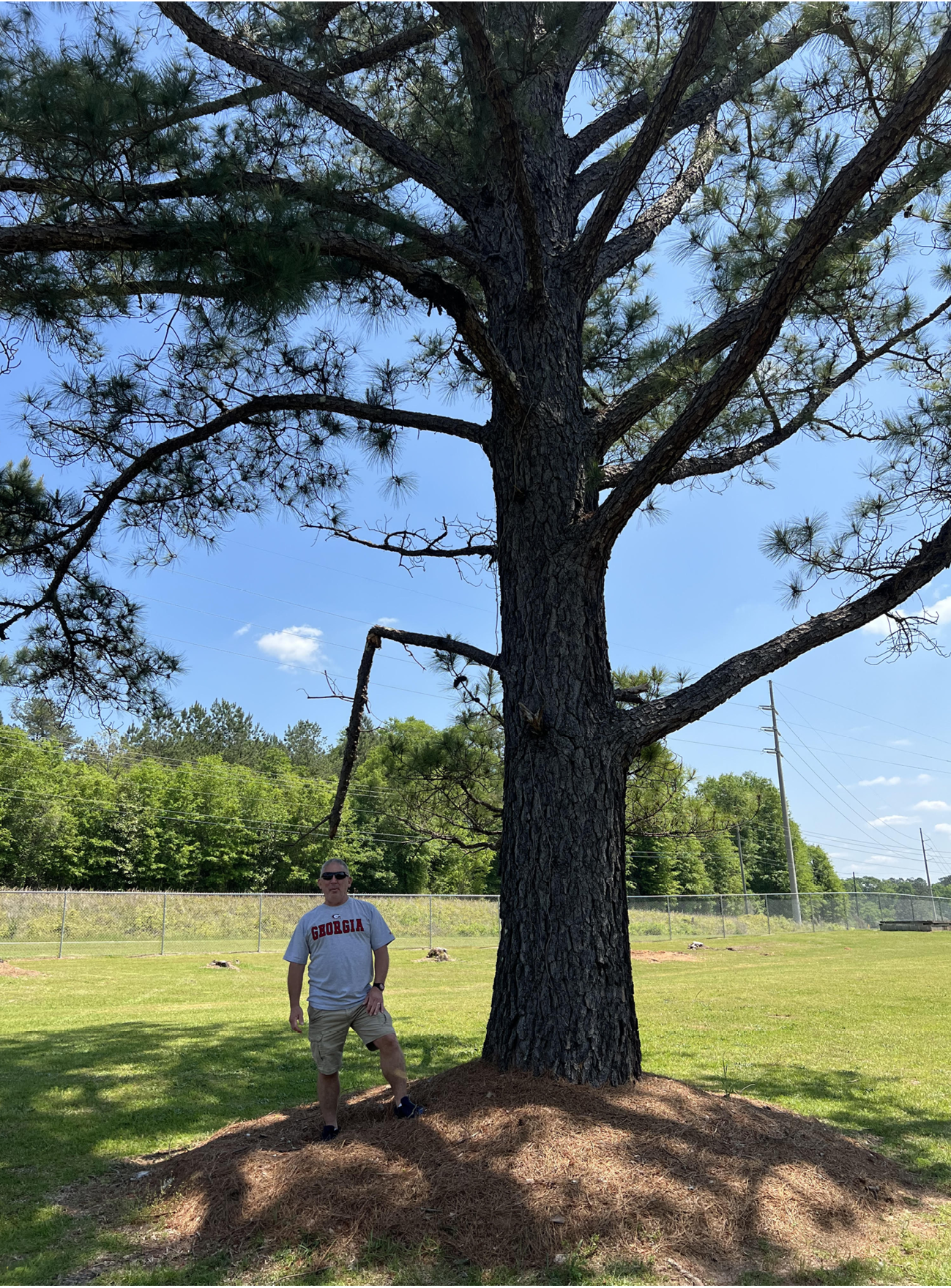
Figure 8.
Ben Bradshaw standing next to the Macon Moon tree, whose location he was able to identify and confirm.
Source: Melanie J. Ford.
Ben recounted every memory from excitedly raising his hand to volunteer to plant the tree, to getting dressed that morning and their arrival and the planting. It all sounded great, but one thing still bothered me, and that was that the fence line wasn’t quite right with the image in the photograph. The roadway profile and the tree aligned with the photograph, but not the fence. I commented on that, and the facilities manager casually said, ‘oh, we replaced that fence a few years ago’. I inquired what the height was previously, and he held his hand off the ground a few feet. That clarified the discrepancy, and we were able to solidify the location of another Georgia Moon Tree.
Bracey, Virginia
While most Moon Trees were planted in prominent public locations, NASA’s Moon Tree website identified one individual situated on private property in Bracey, Virginia. The tree’s street address indicated that it was located within the River Ridge Campground. A phone call to the campground revealed that it was a gated, residential community and that visitors were prohibited unless expressly invited by a resident. I implored the person on the other end of the phone, the office manager, to allow me to visit the site, explaining that I wished to photograph the tree and its surrounding landscape. The request was vehemently denied. I pondered how I could possibly convince the office manager to change her mind, and it occurred to me that, much like the Moon Trees, I needed to uncover a community connection with the tree. I recalled that the name of the person who planted the tree was Lavern Toone (Figure 9), so I asked if he was a resident. The manager’s voice softened, and she stated that Lavern was a long-time former resident who had passed away only a couple of years ago. I said that the tree was a national monument of sorts, and I implored her to let me see it. She checked with her supervisor and confirmed that I could visit the tree.

Figure 9.
Lavern Toone, the man who planted the Moon Tree in Bracey, Virginia.
Source: Donna Toone.
Upon arrival, I was rather surprised to find that the community was not a well-to-do exclusive neighbourhood as I had assumed. What had been established in the 1970s as a summer season occupancy lakefront property and primitive campground, had subsequently grown into a collection of year-round residents who had placed permanent trailers or constructed ramshackle houses on their small lots. I met the facility manager at the entrance gate, introduced myself, and was surprised when the manager said, ‘Okay, where do we go? Where is this tree located?’ I indicated that I really didn’t know. I only knew that Lavern had planted it. My daughter and I climbed into the manager’s golf cart, and together we headed towards Lavern’s former residence, assuming that perhaps it may have been planted there.
A quick walk around the premises revealed there was no Moon Tree on the site. The rear of the house was a patchwork quilt of cobbled-together materials, and the site was not much larger than the house itself. However, looking at the house from the roadway gave no evidence of what the rear of the house looked like, and Lavern seemed to take great care of the house and yard that was visible to passersby. The manager was puzzled as to the potential whereabouts of the Moon Tree, and my daughter suggested that she look at the image of the tree from NASA’s website on my phone. The tree had a very distinctive tombstone-like, fully engraved granite marker at its trunk base that would seem to be difficult to overlook. The manager noticed that the picture indicated that the tree was in an open space. As all the houses in the campground were close together, she suggested there were only two open space areas where she thought it might be.
As we travelled to the first of the two open spaces the facility manager suggested, we met one of the facility maintenance crew members travelling in the opposite direction in a similar golf cart. The manager stopped to ask him if he knew the whereabouts of the Moon Tree. He was unfamiliar with it. As we arrived at the first open space, it became apparent that the tree was not there. Fortunately, we encountered another man in another golf cart travelling in the opposite direction, and he happened to be the former neighbour of Lavern Toone. No sooner did the manager inquire as to whether he knew of the Moon Tree than he exuberantly exclaimed, ‘Oh yes! Of course! Lavern talked about it often. I will take you right to it’. Ironically, the tree was situated just near the entrance to the residential community (Figure 10). We had passed it on the way to Lavern’s place without even noticing it.
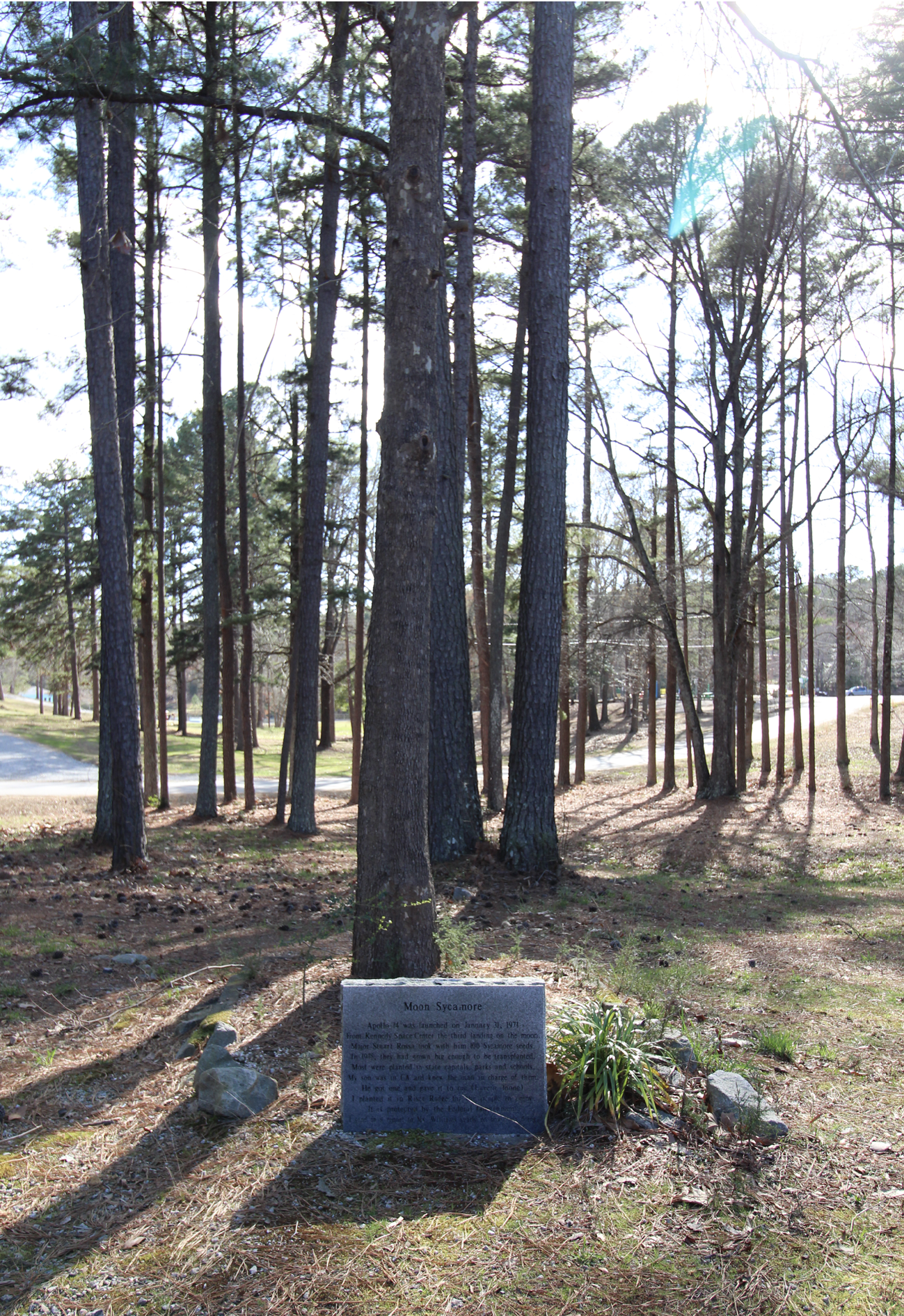
Figure 10.
The Moon tree planted by Lavern Toone at the River Ridge Campground in Bracey, Virginia.
Source: Melanie J. Ford.
After photographing the tree and its surroundings, I noted nothing about the site that was extraordinary, nor did anything about the tree’s form and growth pattern seem unusual. As we left, the office manager mentioned that she had Lavern’s daughter Donna’s phone number and would have her call me, and, several days later, she did. She told me about her father’s passion for the tree, how it had inspired him and energised him, given him purpose and provided him with something that he saw as extraordinary to share within the community that he lived in and loved.
Concluding thoughts
Twenty years after the Moon Trees were planted in communities across the US – many of which were, over time, forgotten – a simple lesson plan from an elementary school teacher brought their plight to the attention of NASA archivist Dave Williams. His inquiry into their story marked the beginning of their journey toward rediscovery. Since then, the quest to locate and identify these trees has become a shared passion for a small but growing community of enthusiasts across the United States. Among these is Rosemary Roosa, daughter of astronaut Stuart Roosa, who is also spearheading an effort to distribute second-generation Moon Trees across the world.
The website created by Williams, titled The Moon Trees, has become a central hub for this ongoing journey. People are invited to submit images and information about known Moon Trees, and Williams updates the website once he has verified the information’s accuracy.9 The site offers a brief history of the trees, a biography of Stuart Roosa (the astronaut who made it possible), and a table of known Moon Tree locations. This table not only distinguishes between surviving and lost trees but also highlights trees reported by the public but not yet verified, offering clickable links to images and media coverage related to each site. Through the website, the dedicated work of volunteers, and the growing network of ‘arboreal detectives,’ we are slowly answering the question: Where on Earth are the Moon Trees?
Currently, there are 66 living Moon Trees with known locations across the United States. Sadly, 45 have been lost due to natural disasters, site development or age, but the hope remains that there could be up to 389 more, their locations still undiscovered. As we reflect on the Moon Trees’ survival, it is clear their existence depends on more than just soil and sunlight. The weaving of networks-of care-is essential. These networks span from the soil to the stories, from the trees themselves to the people who care for them. Some Moon Trees endure in landscapes that have remained largely unchanged since they were planted. Others stand out in highly curated environments, designed to make them symbols of significance. Neither approach is inherently better than the other; both reflect the different ways people connect to place.
The stories of these trees share a common thread: their growth and significance are deeply intertwined with the communities that tend to them. What began as a simple tree planted for a national celebration evolved into a deeper, more lasting relationship between people and the trees. There is an immeasurable amount of research and written documentation describing the historical and social significance of tree-planting. Tree plantings create a gathering point and foster a sense of place, a location to build connections, both with the community and with the tree. They are seen to symbolise growth, wisdom, longevity and a connection to the past.10 Taking a lesson from history, these Moon Trees, symbols of ‘sense of place’, embody something far greater than their botanical makeup.
Each Moon Tree has a story to share, and it is through these stories that they persist. They rely on their networks of communities, caretakers and passionate individuals like Rosemary Roosa, Dave Williams and Lavern Toone (who in caring for his tree established a monument dedicated to its legacy). These are only a few of the many contributors to the Moon Trees’ survival. Together, they demonstrate the agency of the trees, whose resilience and connection to the Moon continue to enrich the lives of the people around them.
So, is a tree that grew from a seed that traveled to the Moon and back ‘just’ a tree? The answer lies in the countless stories told and retold, in the landscapes transformed by their presence, and in the people who continue to care for them. The answer, ultimately, is no.
Melanie J. Ford is Senior Director of Construction for the Office of the University Architects at the University of Georgia (UGA). Her responsibilities are varied and include general oversight of capital construction projects and major renovations on UGA’s campus. Melanie received a Bachelor of Science in Building Science at Auburn University, working as a contractor for twenty years. Her career as a contractor focused on historic preservation and adaptive use projects for both the public and private sector. She joined the UGA team in 2007 and earned a Master’s of Historic Preservation from UGA in 2016 and a Master’s of Landscape Architecture in 2024, while working full-time. Melanie is President of the Georgia chapter of Construction Owner’s Association of America and the founder and President of the Athens Area Women in Construction, a non-profit corporation that focuses on educating the next generation of young women about careers in the construction industry. She speaks frequently at industry conferences and continues to explore moon trees across the United States in her spare time.
Email: mjford@uga.edu
Eric MacDonald grew up on a hobby farm in rural Michigan, where his love of landscapes began. After earning degrees in architecture and urban planning, he worked in public sector historic preservation before returning to graduate school to pursue a Ph.D. in Land Resources at the University of Wisconsin-Madison. His dissertation explored the intersecting discourses of ecology and landscape architecture in the late nineteenth-century North America. Since 2005 he has taught landscape architecture and historic preservation at the College of Environment and Design, University of Georgia, USA. His research focuses on environmental history and cultural landscape management.
Email: eamacdon@uga.edu
1 New Mexico Museum of Space History: https://nmspacemuseum.org/ (accessed 11 Aug. 2023).
2 NASA’s History Division: www.history.nasa.gov (accessed 11 Aug. 2024).
3 NASA – Items Taken Into Space Reflect Accomplishments on Earth: https://history2.nasa.gov/items_carried.html (accessed 29 March 2025).
4 David R. Williams, ‘The Moon Trees’, NASA Space Science Data Coordinated Archive: https://nssdc.gsfc.nasa.gov/planetary/lunar/Moon_tree.html (accessed 24 Aug. 2023).
5 Sertoma: www.sertoma.org (accessed 11 Sept. 2024).
6 Phillip Seagraves, telephone conversation with the author, 2021.
7 ‘The Moon Tree Arrives’, Athens Banner Herald, 16 May 1976.
8 Ed Grisamore, ‘Nearly 50 Years Later, Macon Reconnects with its Moon Tree’, The Macon Melody, 28 June 2024.
9 David Williams, telephone conversation with the author, 2021.
10 https://www.nrpa.org/parks-recreation-magazine/2024/may/the-historical-and-cultural-significance-of-trees (accessed 29 March 2025).