Christina Hourigan
Tree Biographies and the Cultural History of Place at the Royal Botanic Gardens, Kew*
PLANT PERSPECTIVES 2/2 - 2025: 285–301
doi: 10.3197/whppp.63876246815901
Open Access CC BY 4.0 © The Author
Abstract
Trees can be invested with, and accumulate, cultural history and meaning. In gardens they are often also markers of events, entangled relationships, journeys and ideas, and are central to the making of place. This article introduces and discusses the notion of ‘tree biographies’ developed from the object biography approach common in museum studies. Through this interdisciplinary process, the unique significance and cultural value of a tree can be fully recognised alongside a deeper understanding of its contribution to the landscape. An example of this approach, used at the Royal Botanic Gardens, Kew, is presented in discussion of the biography of a deodar cedar from India. This article concludes by addressing the opportunities this methodology can present and how, by exposing the fascinating histories of such potent objects, we can animate the story of our landscapes.
KEYWORDS
trees, tree cultures, embodied history, object biography, Kew Gardens, plant humanities
 Over recent years, trees have been the subject of a large and growing popular literature concerned with the cultural meanings and uses of familiar species such as the oak, ash or hawthorn, as well as exploring the history of the relationship between people and plants in particular places and landscapes.1 These works promise to restore a much-needed context and sense of appreciation for the trees that surround us, sentiments that have a powerful appeal in our nature-depleted societies. Our need for connection to, and understanding of, such long-lived and important life-forms, how they embody their space and tell their stories, has now extended into diverse disciplines.2 The cultural histories of woods and forests have been considered by Charles Watkins and others including Oliver Rackham, while Owain Jones and Paul Cloke interrogated the agency of trees in the continuous unfolding of place and culture.3 Building upon such work, here I focus on the challenge of telling stories about specific living trees, beyond simple narratives of non-human lives. Here, I consider the ways in which we can enrich the history of a landscape or garden by offering new perspectives on the cultural lives, value and significance of the trees that live there. Exploring the story of one tree in situ can reveal new layers of context regarding the place, people and practices that surround it. My formulation of these histories in terms of ‘tree biographies’ seeks to use and adapt an existing methodology, drawn from the field of museum studies, in a quite different context: a living garden.4 The necessarily interdisciplinary nature of the research required to create such biographies places this methodology within the realm of the Plant Humanities, reflecting the unparalleled significance of plants to human culture.5
From object biography to tree biography
Objects have life stories. That is the contention of historians of material culture who seek to explore both the history of individual objects and how those objects have affected history. The approach of object biography has gathered pace over recent decades and is used to better understand our collective social and cultural history through the significance and relevance of individual objects (usually, though not exclusively, museum objects). What has become clear is that it is not just ‘important’ or well-known objects that best reveal such histories, but the ‘everyday’ and the overlooked too. This genre narrates the history and context of an item, its cultural and social importance, but also its mutability.6 Anne Gerritson’s use of the history of a soya sauce bottle and its contents explored the history of food and dining, manufacturing and marketing in the early nineteenth century.7 Others have focused on ‘reanimating’ museum objects and the processes of the making of a museum collection through the story of one preserved specimen – for example the examination of the life ecology and cultural perceptions of the hen harrier by Merle Patchett et al., and Caroline Cornish’s use of economic botany objects to explore the importance and global connections within RBG Kew’s Economic Botany Museum.8 These diverse approaches of object biography all reveal hidden worlds and aid understanding of global connections by moving from the micro to the macro view. They seek to ‘reconnect objects to the cultural aspects not only of the society where they originated … but also of the collecting, and specimen-making society’.9 As Chris Gosden and Yvonne Marshall have reflected:
The notion of the biography of objects goes back to [Igor] Kopytoff (1986) who felt that things could not be fully understood at just one point in their existence and … had to be looked at as a whole. Not only do objects change through their existence, but they often have the capability of accumulating histories, so that the present significance of an object derives from the persons and events to which it is connected.10
If we can judge that museum objects have ‘accumulated’ life histories – each made unique by the individual journeys they have taken and bearing the traces of the people who have encountered them – and if we accept that those objects can change in meaning and purpose as time progresses, then some trees – especially those in curated living collections or gardens – are obvious subjects for biographical treatment. Trees can have lifespans that cover centuries and can live and be present through several eras of human history. They fit within the Western concept of the ‘life cycle’ – or span – of birth, maturity, old age and, in so doing, also create many connections. Their ‘journey’ can involve not just the classic elements of an object biography: movement, trade, specimen-making, changing cultural context etc., but also, as organic beings with their own lives, they will have an innate physical mutability. They are part of the ecological and cultural tapestry of specific places. An individual tree can embody its own history of the events and encounters it has lived through. It can change in form and respond to the environment as it grows from a seed to a sapling and into maturity and thence through old age, death and decay. It can bear the marks (sometimes physically) of collectors, traders, growers, gardeners, visitors and other life – animals, plants and fungi – that interact with it. Each element of this mutability can affect how a tree is perceived, valued and treated, but each also reflects the significance of the tree in that place.
Just as Patchett et al. looked to renew the life of their hen harrier specimen through ‘stories of human-animal encounter … to elicit different kinds of knowledge and viewpoints about them’, looking at life, death and afterlife, so a tree’s own unique story of multiple encounters can be gathered from a range of materials and viewed from different perspectives over its lifetime.11 Caitlin DeSilvey describes such subjects as ‘potent objects’ that can radiate ‘potential paths of inquiry … complex and mobile geographies’ and that an ‘artifact [can be] a process rather than a stable entity’ or can come to be more symbolic than practical, a holder of cultural memory or the recording of the circulation of value.12 And, as Cornish has revealed, applying object biography methods can reveal the global nature and inter-relatedness of many collections, while allowing for a better understanding of ‘meaning-making’ through objects.13 Objects gain meaning and accumulate cultural histories through interaction with us as humans, and the focus of the authors above is on the social and cultural lives of ‘things’ in that context. These concepts align with the idea of living trees as ‘objects’ as people across diverse cultures encounter them, and invest distinct meanings, symbolism, narratives, and values onto them. Trees are central points of connection within a larger web of stories. They can grow and change to become cultural or sacred symbols, markers of horticultural activity or landscape change – ‘meeting places of nature and human labour … designed to have value’.14 They can also undergo what Setsu Tachibana and Charles Watkins have called, ‘botanical transculturation’ transforming from the ‘exotic’ to the ‘culturally assimilated’.15
Adopting this ‘tree biography’ approach can unlock fresh perspectives on trees as embodiments of cultural memory, allowing a deeper interrogation of them as sites of meaning. Here, I focus on plant–people relationships to tell a life story of a tree, which then aids our understanding of the landscape it dwells within and the cultural history that shaped it. In my own research, I have used this methodology to address the life stories of trees curated within the arboretum of the Royal Botanic Gardens, Kew, but hope that it may be of relevance to other types of arboreal landscapes.
Tree biography at the Royal Botanic Gardens, Kew
Trees have long had both practical and cultural significance to us, but they are also ‘skilled place makers’.16 This is exemplified in living tree collections known as arboreta – ‘living museums’ of tree species and cultivated varieties.17 Just as a museum revolves around the diversity and importance of its objects, an arboretum is a collection of living artefacts which in themselves are a collection of individual stories, making not only each tree unique but each assemblage of trees unique. Today, around 12,000 trees of over 2,000 taxa grow in the arboretum at the Royal Botanic Gardens, Kew, collected from a vast range of temperate habitats from around the world. Many have been collected as an exemplar of their species, or for a conservation purpose, and have arrived via a network of botanical actors to become living ‘scientific specimens’ within the arboretum. These trees have then continued to accumulate and embody new histories, values and meanings determined by the new environmental and social parameters under which they have been displayed. The majority of trees in this setting have been collected, transported, catalogued and curated over their lifetimes as ‘living treasures’.
Tree biography as a methodology does not aim to create a straightforward narrative of a linear timeline but aims to explore and bring together archival, scientific, horticultural, illustrative and literary sources and objects in an exploration of the life, value and context of an individual tree. This is appropriate at an historic and well-archived institution such as Kew, where diverse research materials across different collections are available, and it is acknowledged that such institutions are rare. However, as Jones and Cloke consider, within any treescape trees will naturally ‘play an active role, projecting themselves into political, cultural and economic fabrics’ and that they are ‘often emblematic of the wider environment’ where their ‘shadowy meaningfulness’ has much to offer.18 The unique lens of this approach at Kew can reveal both the significance and agency of an individual tree but also the voices and contributions of previously unseen individuals and their importance to the creation, management, successes and failures, and overall purpose of the tree collections. Not all trees are enfolded by records that can help us to tell their stories, but in certain cases they can embody and expose fascinating narratives, animating the history of the landscape. This is a method by which the past can speak to the present.
Understanding the individual and collective significance of trees in this way also relates to work undertaken in the museum sector on ‘object significance’ – a widely accepted curatorial approach.19 This explores how by understanding ‘significance’ through defined criteria, it is possible to unlock the potential and connections of a collection, helping define both the tangible and intangible, ‘creating opportunities for communities to access and enjoy collections and to understand [their] history’.20 Including significance within tree biographies at Kew can inform and guide future curation within the arboretum and the interpretation of selected trees.
The Royal Botanic Gardens, Kew has a complex past dating back to 1759. The arboretum has grown extensively over time and through the work of many different directors, designers, gardeners and collectors.21 The main arboretum began to be planted in the late 1850s and has continued to evolve and change ever since as a living landscape. Kew as a place can be said to be completely made by the plants that grow there.22 Each has been brought from a different place and time and has its own unique story. Many of Kew’s mature trees today were planted over a hundred years ago, in an era of imperial botany, collecting and exchange. In the case of Kew’s global and historic collections, we must consider how the collecting and study of trees became, as Miles Ogborn has described, tied into the political economy and geopolitics of European empires, global networks of trade, naval power and scientific enterprise.23
Using tree biography to uncover the life of a deodar cedar
Halfway along the 300-metre-long Broad Walk at Kew stands a tall evergreen conifer, its elegant sweeping branches bedecked with fat upright grey cones dripping with sticky resin. This is a deodar cedar (Cedrus deodara), one of three surviving specimens of an avenue planted here in 1845. Standing tall among the new ornamental flower beds, its forked large dark-grey trunks act as a foil to the delicate light-green foliage at the ends of its drooping branches (see Figure 1). This tree stands in one of the busiest parts of the Gardens, where millions of people stroll by each year. This was always the intention of the people who designed and planted this space – that the deodar avenue would welcome as many people as possible (see Figure 2). This tree represents a new era of Victorian landscaping and expansion at Kew from a time when it was transformed from a private royal landscape into a national public botanic garden in the 1840s. This individual was also one of the first trees planted outdoors at Kew from the temperate forests of India. It is therefore a potent symbol of landscape change, of new plant networks, and ‘the botanical enterprise of empire’, converging in the making of place.24
Research on this tree engaged with a wide range of archive materials and collections at Kew and beyond. Searching Kew’s own plant database with the tree’s ‘accession number’ (an individual number assigned to each tree), reveals it to be of ‘wild origin’, but with no details of how it was transported into the country from its native India or who collected or planted it. However, contextual research on the introduction of deodars to Britain and a review of Victorian Kew guidebooks, conifer collection handbooks, Kew maps and archival materials including correspondence between directors, designers, and leading botanists of the day, as well as an unpublished history of Kew by the then curator John Smith (1798–1888), all revealed that this tree had played a significant part in the creation of the new aesthetic and symbolism of this innovative national botanic garden in the mid-nineteenth century.
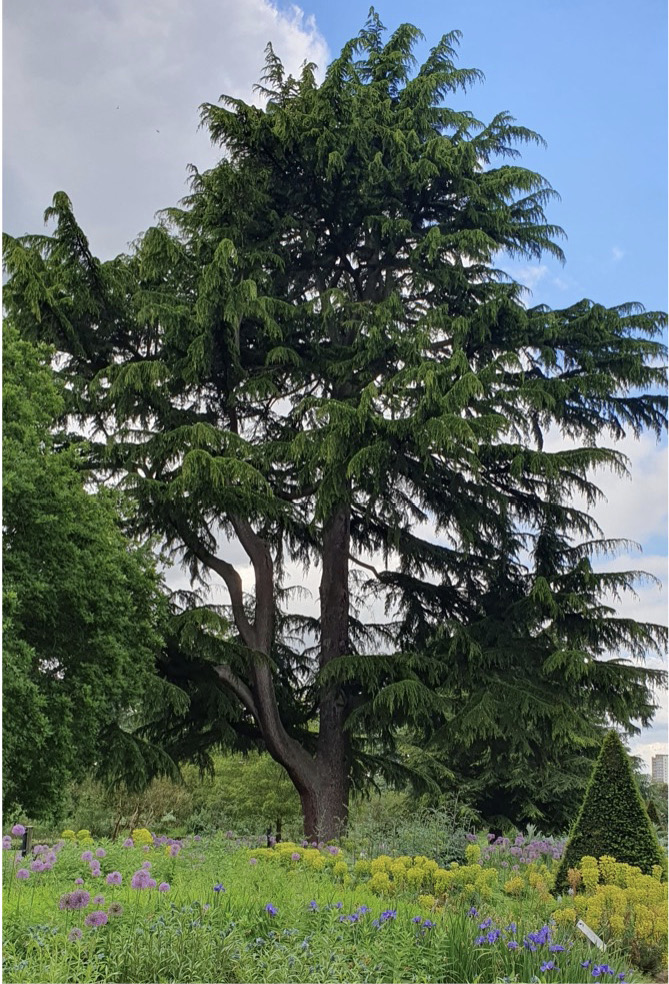
Figure 1.
The specimen of Cedrus deodara or Deodar cedar examined for this tree biography on the Broad Walk at RBG Kew. © Christina Hourigan
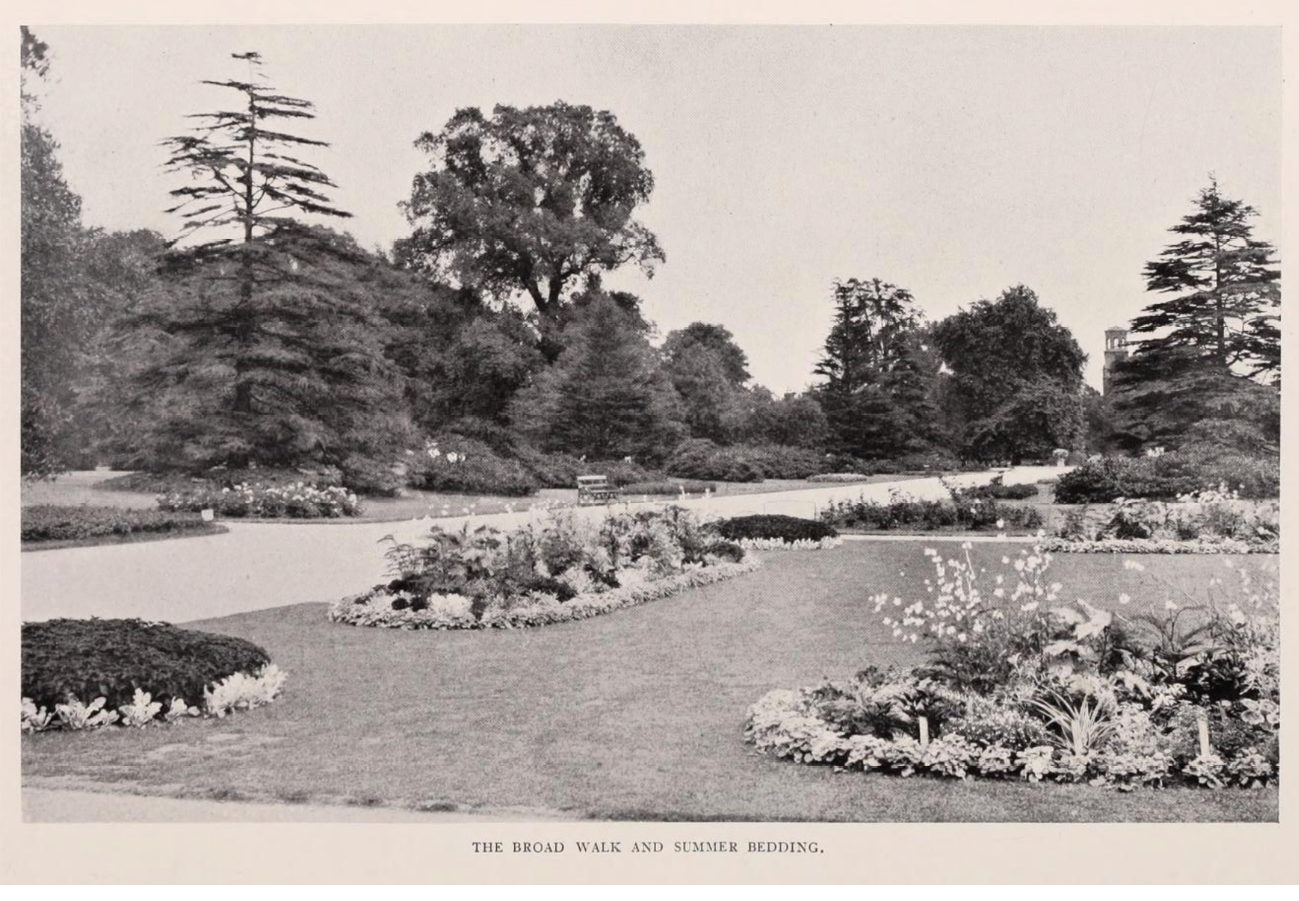
Figure 2.
This image of the Broad Walk by E.J. Wallis published in 1908 shows the deodar avenue and the tree under discussion on the right of the image.
Reproduced from W.J. Bean and William Thistleton-Dyer, The Royal Botanic Gardens, Kew: Historical and Descriptive (London: Cassell and Company, 1908).
It became clear that this tree had likely been grown from a shipment of deodar seed from northern India, imported by the East India Company via India House in London, as many tonnes of seed then were. Kew’s ‘Inwards Book’ for 1842 records a shipment of deodar seed from the East India Company via a Dr Royle.25 The tree was grown on site in a tree nursery (now the site of a tropical nursery) near to where it would be planted, and the work involved in growing it and then creating the avenue reflected the practices and hard labour of horticulture at that time, giving new insights into the often-invisible taskscape of Kew.
Research across the many maps in Kew’s archives showed that the deodar was a key part of the new high-Victorian design by William Andrews Nesfield to transform the older royal Georgian landscape (see Figure 3). It was part of an impressive planting plan, including many fashionable conifers, creating a wide promenade leading up to the new Palm House. The deodars of the Broad Walk (or ‘Deodara Walk’ as Nesfield called it) were to set the stage for visitors entering this new garden – visitors who were, as A.J. Lustig describes, often obsessed with botany and horticulture, and the ‘new aesthetic of connoisseurship and collecting’.26 This physical reordering of the landscape and planting of new ‘exotic’ trees and shrubs along a bold new promenade was a statement of intent in a confident new era of bringing together and displaying the world’s plants for both imperial science and visitor pleasure in these gardens.
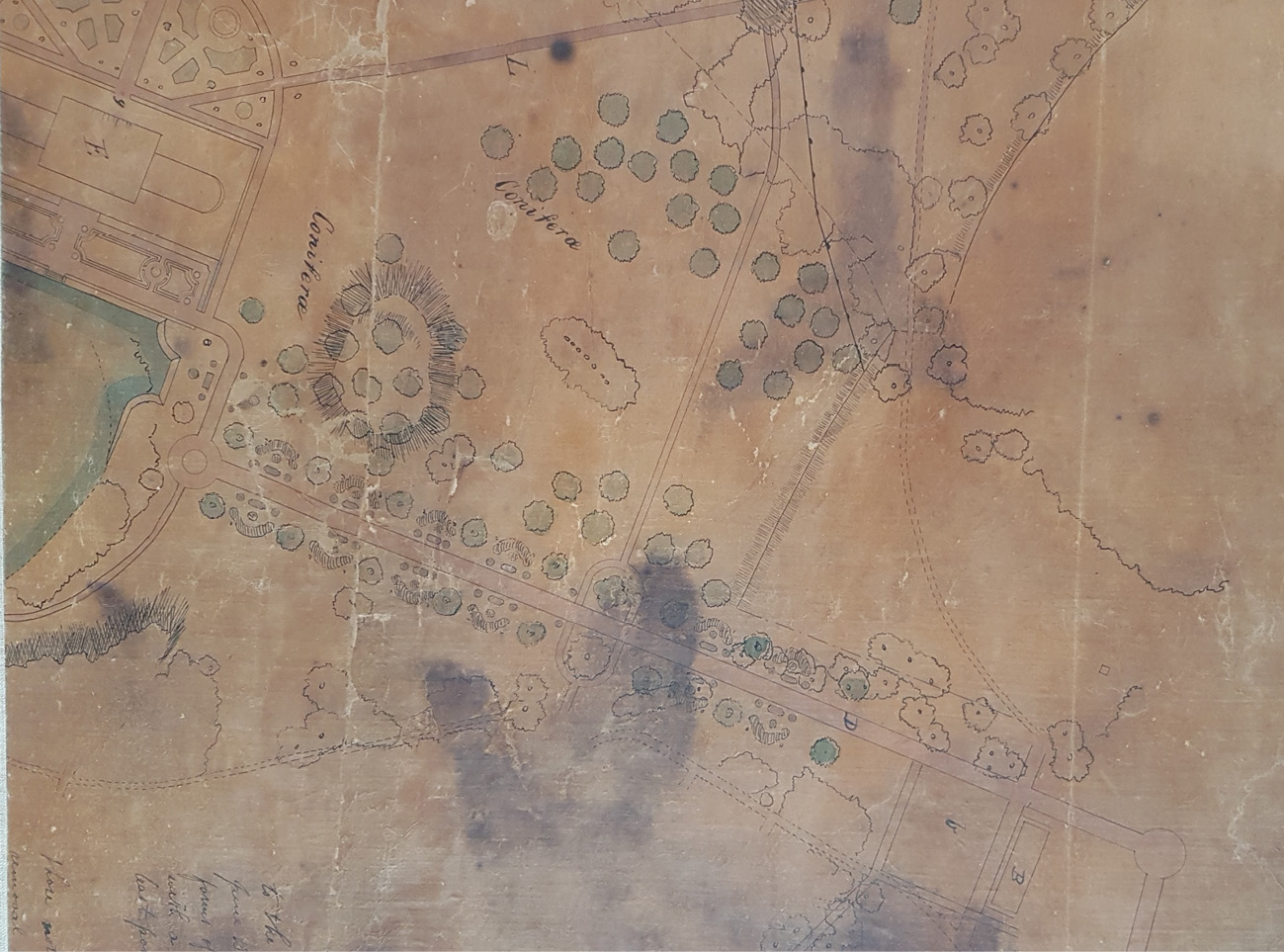
Figure 3.
Portion of a map showing the planned avenue of deodars and ornamental beds to be planted along Kew’s Broad Walk.
Plan of the Pleasure Grounds, W.A. Nesfield, 1845. RBG Kew Archives. Reproduced with the kind permission of the Board of Trustees of the Royal Botanic Gardens Kew.
Kew currently describes the native range of this species as ‘NE. Afghanistan to W. Nepal and NW. India (Morni Hills)’ growing at elevations between 1,300 and 3,300 metres.27 Connecting this deodar back to India allowed for a contextual study of the forests of India at this time, the uses of deodar timber for building, bridges and a vast new railway network, and highlighted the links between Kew, the British-Indian government and the Dehra Dun forestry school in India. The desire for Indian timber had led to large-scale deforestation (and social injustice and unrest) in many areas of northern forest that were once seen as ‘inexhaustible’, despite government-run forest preserves being set up elsewhere in India.28 Indeed, the deodar had been initially introduced to Britain in 1832 as a potential timber tree.29 However, they quickly became popular as ornamental trees, and strong saplings were changing hands in London for two guineas each in 1844.30 Placing this tree in such a historic context allows consideration of its imperial symbolism in this space.
The mobilisation of this Indian tree across continents and oceans to Britain was indicative of the growing botanical networks of the age, as well as the commercialisation of plants found in Britain’s colonies. At the time, Kew described itself as a botanical clearing-house as well as a living museum, of service to the colonies as well as the ‘mother country’, providing specimens, publishing Floras of all the then-known species in a region or country, sharing staff and expertise between colonial gardens.31 Indeed, it prided itself on having a comprehensive herbarium of Indian flora ‘more complete than anything which exists even in India itself’.32 This deodar would have been growing well when Dr Dietrich Brandis, head of the Indian Forest Department, visited Kew for two years to use the herbarium and complete a Forest Flora of North-West and Central India in 1874, while The Flora of British India (1872–1897) was also being undertaken by Kew director Sir Joseph Hooker. Mentions of deodar abound across Kew’s Library and Archive materials – in correspondence, government memos, illustrations, photographs and books, as well as in Kew’s Economic Botany Collection. These, along with the living display of a deodar at Kew in such a prominent position, reflect the Victorian fascination with Indian plants and products. Such trees can therefore easily tell histories of multiple places and reflect the complex politics of the time.
Examining the embodied history of a tree of course includes addressing the character of it as an individual, how it sits within the landscape, shapes its own environment, and bears the marks of its own interactions with its surrounding ecology, as well as the people who care for it. This tree’s physical form and size shows clear marks of its survival over 180 years reacting to the less-than-ideal conditions of Kew’s free-draining soils, cold, wet or frosty winters and plenty of Victorian air pollution, for this is by no means the finest example of its species. It has reacted over the years both to the angle of the sun and the compaction of many visitors’ feet by growing far better on the side away from the Broad Walk. Seen from the lawned area away from the path it presents a different face with an abundance of sweeping branches and foliage where it has space to grow. Despite having large limbs pruned away in the past it has healed its wounds and continues to thrive even in the challenging soil and climate there.
It is lucky to have survived, as many horticultural writers of the time describe the immense failure rate of deodars, many dying off before they reached forty years of age.33 Kew was no exception. Its second director Sir Joseph Hooker recorded the toll that severe frosts took on young deodars, killing their leader stems. In a letter of January 1854 in Kew’s archives Hooker wrote to his American friend and botanist Asa Gray saying: ‘As to our Deodar Avenue of Kew it is the seediest most ragged affair you ever saw … these were all seed raised; had we planted cuttings as nurserymen do, of the most weeping glaucous long leaved strips, what a different thing we should have had.’34 Indeed, although deodars were planted on all the main vistas at Kew in the mid-nineteenth-century, nearly all of them failed. Photographs of Kew through the nineteenth and early twentieth centuries show the success and failure of individual trees along the Broad Walk as time progressed. It has been speculated that this failure may have been due to the seed having been collected from trees from too low an altitude in India making the cedars grown from them in Britain not hardy enough for British winters. The worst specimens on the Broad Walk were removed and replaced in 1913 by Atlantic cedars (Cedrus atlantica) and other species which were then considered to be better suited to the British climate. The fate of many of Kew’s deodars reflects the constant changes and struggle of the early Victorian arboretum at Kew. Archive materials clearly record many tree failures and the re-workings of the arboretum planting plan under successive directors in the nineteenth and early twentieth centuries. To view the three remaining deodars on the Broad Walk and the handful on Pagoda Vista is therefore to witness the remnants a former layer of Kew’s design and vision.
This now mature deodar is a fundamental part of the ornamental aesthetic of this area of the Gardens. Although prominent, it is now often overlooked – a piece of green theatre on a grand processional walkway towards the Palm House – but it is a holder of cultural memory and connections which need to be re-animated to give greater meaning to this site. Its meaning and value in this space as it has matured and survived have only grown. Remarkably, however, new scientific research in progress by Kew’s current head of the tree collections, Kevin Martin, shows that climate change may bring a new era of success for the deodar at Kew and more may now be planted, possibly even from the seed of this very tree, offering it a new ‘afterlife’ in its progeny.35
Other individual trees of different species researched using this approach have revealed the embodied stories of the global nature of research and collecting at Kew, plant mobility, economic trade in tree parts, museum collection-building, a national and international network of horticultural expertise, and the hidden stories of little-known collectors and Kew gardeners whose contributions to the history of the collections and landscape have so far been underappreciated. They have also highlighted the absence of certain archival records, notably of indigenous collectors in a variety of countries. Each biography has added to the understanding of the contribution of trees to this landscape as a scientific and cultural living museum. These trees were planted at a time when botanical knowledge imbued many elements of a society steered towards ‘improvement’, and an era when science and horticulture worked closely together.36
As a tree is a living organic being, there are many nuances and distinct opportunities in using an object biography approach. At places such as Kew, trees can have multiple physical lives, in contrast to most inorganic museum objects. An accessioned tree can have had parts pressed into herbarium specimens, or used to make microscope slides, economic botany objects, or botanical art, as well as the fact that any tree will have created many living progeny (via seeds or genetically identical scions) and these will have been planted elsewhere at Kew or shared with other gardens. The creation of new lives from one accessioned tree can offer a wealth of opportunities for reflecting upon the value and significance of the mother tree. The connection points and paths of inquiry can be many and varied, with each tree a central node in its own web of interaction with places, people, other objects, events or experiments. As Kopytoff considered – in an object’s life it is the new relationships that are formed, and how an object is used, adopted or redefined by different people or cultures that can reveal much about both culture and object.37
Leonie Hannan and Sarah Longair remind us that ‘the question of value has been central to the study of material culture’ and trees can of course be valued in many ways – from economic to ornamental and for their rarity.38 The weight of a value attached to an individual tree is increased if it has been given as a gift, planted by a notable person, collected by a famous ‘plant hunter’, or a renowned nurseryman, or it may be considered to have contributed to society or the advancement of science in a particular way. Different values placed upon a tree leave a lasting trace on how it continues to be perceived or used. How we then interpret that value and how we display such a tree – for researchers or for the public - can in itself also have meaning.39
Conclusion
As I have attempted to demonstrate, the approach of ‘tree biographies’ can offer a new way to view the accumulated histories and lives of individual trees revealing their value, significance and legacy. Curated trees, such as those in botanic gardens, offer a specific opportunity to view them as makers of place as well as markers of time, as ‘meeting places of nature and human labour’, reanimating the historic layers of a landscape.40 Trees are not only rooted embodiments of cultural history but gateways to a wider understanding of the web of global connections that exist within many of our gardens and treescapes. While the deodar at Kew was a potent symbol of an imperial scientific vision within a Victorian landscape, each tree can offer a different perspective on, and a deeper understanding of, the same place, if allowed to tell its story.
Acknowledgements
I would like to thank my Ph.D. supervisor Felix Driver at Royal Holloway, University of London, for his support while I have developed this approach, as well as the staff of the Archives and Library at the Royal Botanic Gardens, Kew, and the two anonymous reviewers for their comments.
Christina Hourigan is an AHRC techne-funded CDA Ph.D. student in the Dept of Geography, Royal Holloway, University of London, and at the Royal Botanic Gardens, Kew. Her research entitled The Making of a Global Arboretum focuses on the cultural history of the arboretum using RBG Kew as a case study, exploring the themes of landscape, place, collections, botanical networks, and the histories of science and horticulture on site. She is also the author of several titles on trees as Christina Harrison, most recently including Bedgebury Florilegium (London: Kew Publishing, 2025) and Among the Giants, a Year at Kew’s Arboretum (London: Octopus Publishing, 2025).
Email: Christina.Hourigan.2020@live.rhul.ac.uk
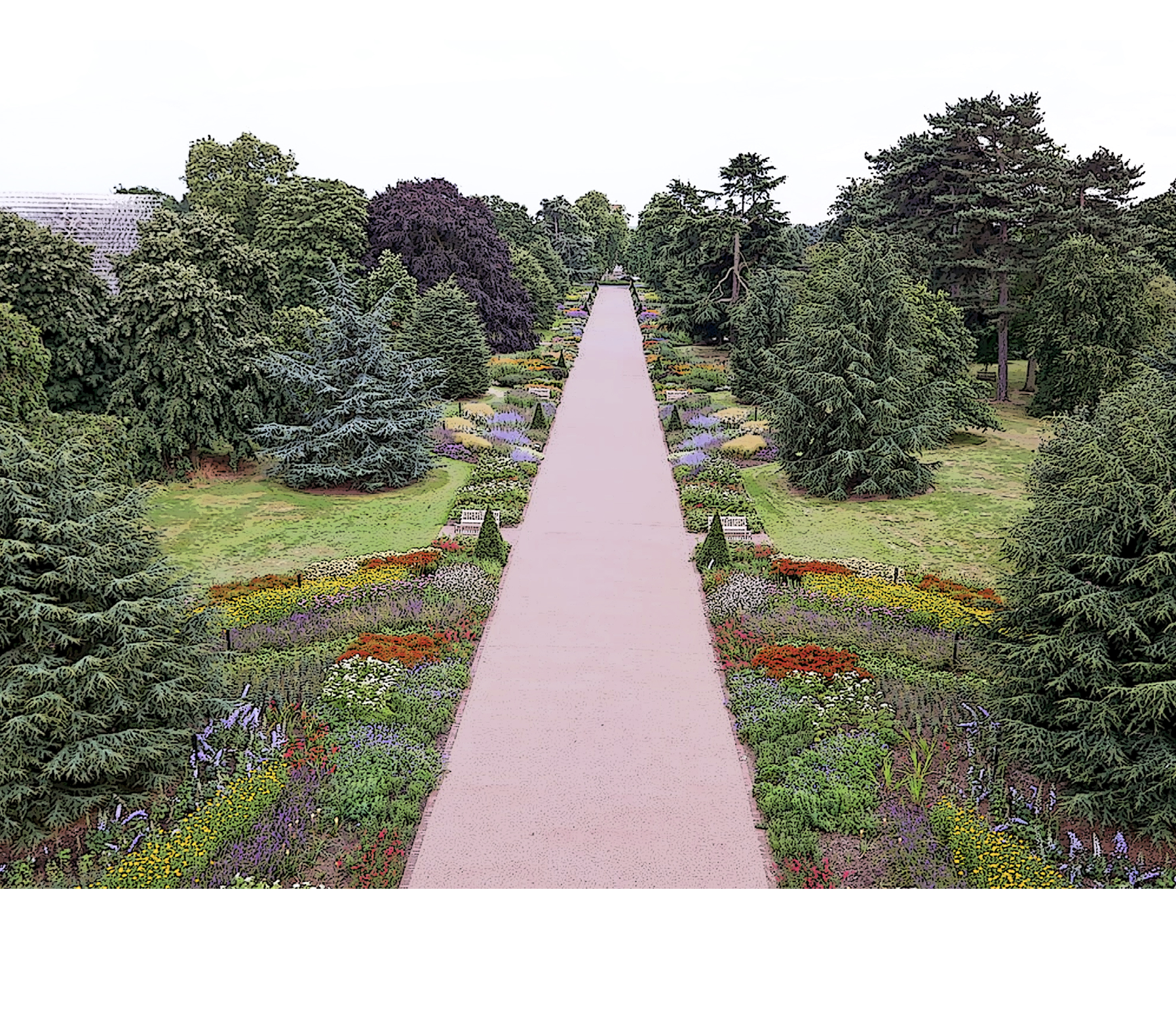
1* Title page image reproduced by kind permission of the Board of Trustees of the Royal Botanic Gardens, Kew.
For example: F. Stafford, The Long, Long Life of Trees (New Haven: Yale, 2016); nature writing such as J. Canton, The Oak Papers (Edinburgh: Canongate Books, 2020); as well as sweeping novels such as A. Proulx, Barkskins (London: Fourth Estate, 2016).
2 See, for example, D. Nassar and M. Barbour, ‘Tree stories, the embodied history of trees and environmental ethics’, Cultural Politics 19 (1) (2023): 128–47; M. Battles, Tree (New York: Bloomsbury Academic, 2017).
3 C. Watkins, Trees, Woods and Forests: A Social and Cultural History (London: Reaktion Books, 2014); O. Rackham, Trees and Woodland in the British Landscape (London: Weidenfeld & Nicholson, 2020); O. Jones and P. Cloke, Tree Cultures: The Place of Trees and Trees in Their Place (Oxford: Berg, 2002).
4 Tree biographies form an integral part of C. Hourigan, The Making of a Global Arboretum: The Case of the Royal Botanic Gardens, Kew (Ph.D. thesis, forthcoming, Department of Geography, Royal Holloway, University of London).
5 F. Driver, C. Cornish and M. Nesbitt, Plant Humanities: Where Arts, Humanities & Plants Meet, Final report to AHRC (2021), p. 4.
6 E. Lilje and J. Philip, ‘The dancing trees: Objects, facts and ideas in museums’, in From Field to Museum – Studies from Melanesia in Honour of Robin Torrence, ed. by J. Specht, V. Attenbrow and J. Allen, Technical Reports of the Australian Museum (Online) 34 (2021): 183–94.
7 A. Gerritsen, ‘The global life of a soya bottle’, inaugural lecture, University of Leiden (2014): https://scholarlypublications.universiteitleiden.nl/access/item%3A3140344/view
8 M. Patchett, K. Foster and H. Lorimer, ‘The biogeographies of a hollow-eyed harrier’, in The Afterlives of Animals: A Museum Menagerie (Charlottesville: University of Virginia Press, 2011), pp. 110–33; C. Cornish, Curating Science in an Age of Empire: Kew’s Museum of Economic Botany. (Ph.D. thesis, Department of Geography. Royal Holloway, University of London, 2013).
9 Lilje and Philip, ‘The dancing trees’, p. 183.
10 C. Gosden and Y. Marshall, ‘The cultural biography of objects’, World Archaeology 31 (2) (1999): 170.
11 Patchett et al., ‘The biogeographies of a hollow-eyed harrier’, p. 112.
12 C. DeSilvey, ‘Object lessons: From batholith to bookend’, in The Wiley-Blackwell Companion to Cultural Geography, (Chichester: Wiley-Blackwell, 2013), pp. 146–58.
13 C. Cornish, ‘Curating global knowledge: The Museum of Economic Botany at Kew Gardens’, in Diarmuid A. Finnegan and Jeffrey J Wright (eds), Spaces of Global Knowledge: Exhibition, Encounter and Exchange in an Age of Empire (Farnham: Ashgate, 2015), pp. 119–42.
14 C. Mukerji, ‘The landscape garden as material culture: Lessons from France’, in The Oxford Handbook of Material Culture Studies (Oxford University Press, 2010), p. 543.
15 S. Tachibana and C. Watkins, ‘Botanical transculturation: Japanese and British knowledge and understanding of Aucuba japonica and Larix leptolepis 1700–1920’, Environment and History 16 (1) (2010): 43–71.
16 Jones and Cloke, Tree Cultures, p. 10.
17 See P.A. Elliott, C. Watkins and S. Daniels, The British Arboretum: Trees, Science and Culture in the Nineteenth Century (London: Pickering and Chatto, 2011).
18 Jones and Cloke, Tree Cultures, pp. 7 and 2.
19 T. Ireland, S. Brown and J. Schofield, ‘Situating (in)significance’, International Journal of Heritage Studies 26 (9) (2020): 827.
20 R. Russell and K. Winkworth, Significance 2.0. A Guide to Assessing the Significance of Collections (Collections Council of Australia, 2009). p. 1.
21 R. Desmond, The History of Kew, second revised edition (London: Royal Botanic Gardens, Kew, 2007).
22 Hourigan, The Making of a Global Arboretum.
23 M. Ogborn, ‘Vegetable empire’, in Worlds of Natural History (Cambridge: Cambridge University Press, 2018), p. 271.
24 A phrase taken from a speech to the Colonial Society by Kew assistant director W. Thiselton-Dyer, ‘The botanical enterprise of the Empire’ (HMSO, 1880): www.jstor.org/stable/10.2307/60229388
25 Plants Inwards 1828–1847 [1842], Library and Archives, Royal Botanic Gardens, Kew. Other shipments to Kew are referenced in several letters from Royle (superintendent of the East India Company gardens at Saharanpur, India) to W. Hooker from 1843 onwards. See for example: DC/54/409; DC/54/422; DC/55/254 (East Indian Letters, RBG Kew Archives). Also MCR/5/1/26 India Economic Products: D. ff164–187. Library and Archives, RBG, Kew.
26 A.J. Lustig, ‘Cultivating Knowledge in Nineteenth-Century English Gardens’, Science in Context 13 (2) (2000): 166.
27 https://powo.science.kew.org/taxon/urn:lsid:ipni.org:names:676701-1
28 See G.A. Barton, Empire Forestry and the Origins of Environmentalism (Cambridge: Cambridge University Press, 2002); V. Damodaran and R. D’Souza (eds), Commonwealth Forestry and Environmental History: Empire, Forests and Colonial Environments in Africa, the Caribbean, South Asia and New Zealand (Delhi: Primus, 2020).
29 https://www.treesandshrubsonline.org/articles/cedrus/cedrus-deodara/
30 J.C. Loudon, Arboretum et Fruticetum Britannicum, second edition (London: Longman, Brown, Green, and Longmans, 1844), Vol. 4, p. 2432.
31 Thiselton-Dyer, ‘The botanical enterprise of Empire’.
32 Ibid. p. 11.
33 See H.J. Elwes and A. Henry, The Trees of Great Britain and Ireland (Edinburgh, priv. print 1906–1913). Vol. 3, pp. 479 and 481.
34 Letter from Joseph Hooker to Asa Gray, Jan. 1854. JDH/2/22/1/1. f.8. Library and Archives, Royal Botanic Gardens, Kew.
35 S. Toomer, T.H. Freeth and K.W.E. Martin, Planting for the Future: Kew's Landscape Succession Plan (RBG Kew, 2024); H. Sjöman and A. Anderson, The Essential Tree Selection Guide, for Climate Resilience, Carbon Storage, Species Diversity and Other Ecosystem Benefits (Bath: Filbert Press, 2023). The full tree biography of this deodar is included in Hourigan, The Making of a Global Arboretum.
36 A.J. Lustig, ‘Cultivating knowledge’, p. 169.
37 I. Kopytoff, ‘The cultural biography of things: Commoditization as process’, in The Social Life of Things: Commodities in Cultural Perspective (Cambridge: Cambridge University Press, 1986), p. 67.
38 L. Hannan and S. Longair, History through Material Culture, IHR Research Guides (Manchester: Manchester University Press, 2017), p. 53.
39 Ibid., p. 55.
40 Mukerji, ‘The landscape garden as material culture’, p. 543.