Maria Kennedy
Exploring
Un-cultivation in America: Discourses of Wild and Foraged Apples
PLANT PERSPECTIVES 2/2 - 2025: 385–408
doi: 10.3197/whppp.63876246815906
Open Access CC BY 4.0 © The Author
ABSTRACT
This paper explores the existing popular culture discourse of foraging and wild fruit through examinations of orcharding history, longstanding American folk legend, contemporary mass media depictions and niche publications within the cider industry that were circulating within the social networks of cider makers during the time leading to our study. Taken together, these narratives indicate an active and evolving intellectual discourse of foraging within the cider community, a discourse which reveals a questioning and reframing of dominant cultural, social and economic paradigms, not only of contemporary agricultural and social economies, but also of the longer scope of American Romanticism as a foundational cultural imperative. Ideas of the landscape, its uses and its meanings, based in the opposition of wilderness and cultivated landscapes, are under revision in this foraging discourse.
KEYWORDS
Orchards, trees, foraging, apples, cider production, plant humanities, cultivated landscapes, folk legends
 Introduction
In 2019, American cider maker and orchardist Andy Brennan published Uncultivated: Wild Apples, Real Cider, and the Complicated Art of Making a Living, in which he describes his ideology of ‘un-cultivation’. He details the discovery, care, use and propagation of so-called ‘wild’ apples in reforested areas of the Catskill Mountain region of upstate New York as an alternative to conventional forms of cultivation and farm business management.1 Brennan’s ideas have contributed to a groundswell of enthusiasm for apple foraging in the region in recent years. His practice was an early example of a trend amongst producers in the emergent American cider industry who have begun searching for the remnant orchards of abandoned farms and the feral offspring of cultivated trees now scattered in second growth forests across the American Northeast. There is increasing interest in the significance of wild apples as sources of potential new cultivars that are disease-resistant, locally adapted to climate change and expansive in qualities of taste and use in cider. While the practice of foraging in contemporary cider production initially appeared economically marginal, it also seemed increasingly topical, as various craft cider companies began to tout the use of ‘wild’ apples on their labels and in marketing. Discussions of foraged fruit began to emerge in the media from 2013 and in a panel devoted to discussing and tasting foraged fruit ciders at the industry meeting Cider Con in 2018, culminating in the publication of Brennan’s book in 2019.
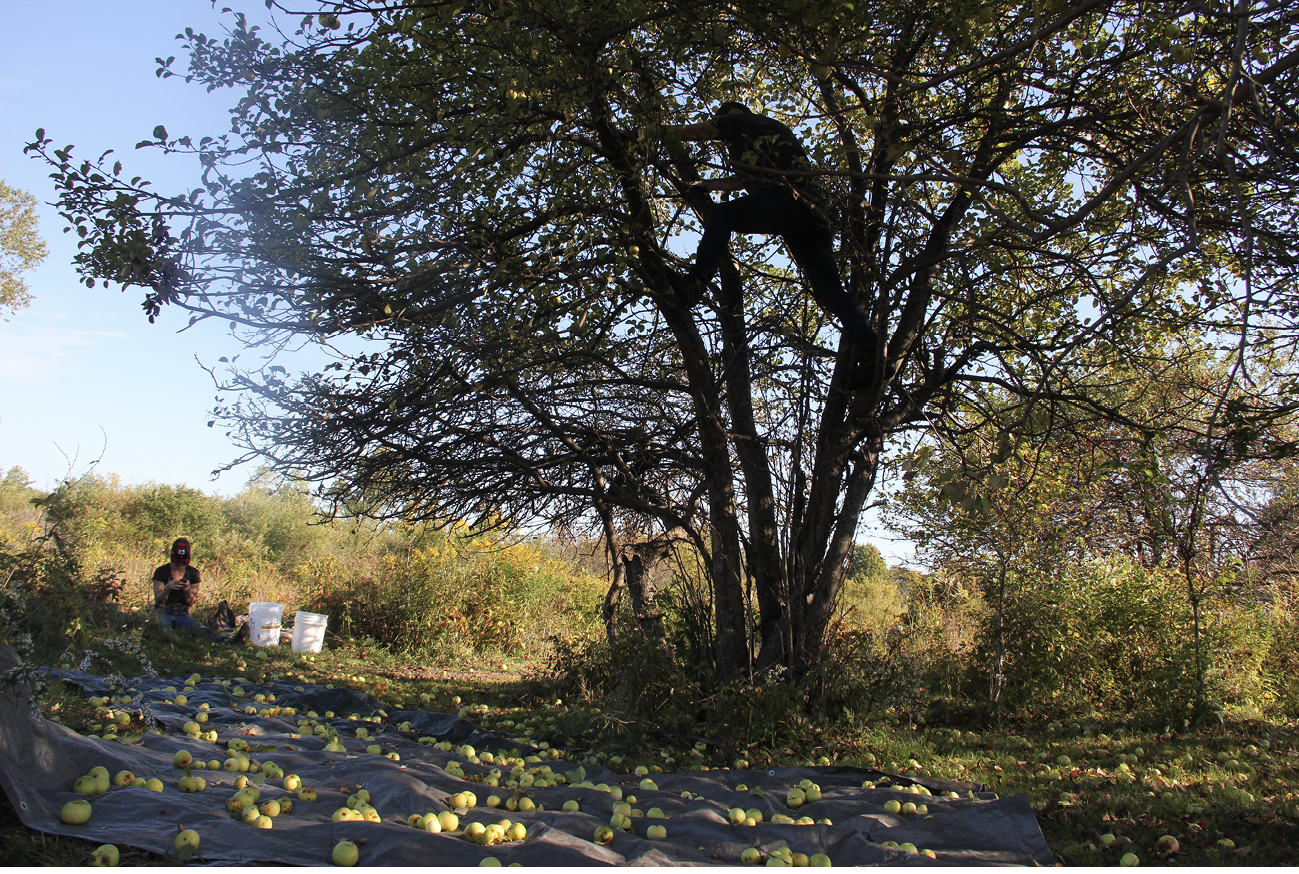
Figure 1.
Apple foragers at a location in upstate New York use tarps to catch the apples on the ground while shaking them off the trees.
Photo: Maria Kennedy.
On a practical, rather than literary, level, we also see the concept of ‘wild’ as a significant component of value in the contemporary cider industry, particularly in the widespread use of the word to describe products. Here, the cultural meanings of wild may be broad. Nevertheless, it is the ubiquity of the word that shows its power in characterising American imaginaries. A recent study of company website descriptions of ciders from New York, Vermont and Virginia using text-mining analysis, documented the common use of the term ‘wild’ in several contexts, including ‘wild apples’, ‘wild fermented’ and ‘wild yeasts’.2 Further, the article states that:
the mention of wild fermentation methods is becoming common in product descriptions, presumably as a way to differentiate products. Wild fermentation methods are also trending in wine-making and brewing … though the details of these processes are not well-understood nor is the use of process-oriented terms regulated by industry stakeholders or governmental organizations.3
Though the use of ‘wild’ in the above study references the fermentation method rather than the apple source, its use across various aspects of cider production reflects a widening arena of descriptive practice attached to this word. In contrast with industrial food products, the value attached to the term ‘wild’ indexes a plethora of meanings that highlight the artisanal value of beverages created with greater connection to nature and processes beyond the control of the maker. At the margins of economic productivity, the value of foraging for wild fruit by cider makers and consumers must be sought in outcomes other than profit.
What qualifies as wild with regards to the apples themselves may be interpreted by foragers in different ways. According to some usages, wild apples might refer to fruit sourced from previously cultivated orchards that have since been abandoned and overgrown with other vegetation and might now resemble a second growth forest. ‘Wild’ here indicates their location in presently uncultivated land. Alternatively, ‘wild’ or ‘feral’ might refer to characteristics of the plants themselves. The apples most commonly used for cider production are from cultivated varieties, meaning that people have selected a unique genotype for specific traits (such as environmental tolerance, disease resistance or fruit quality) and then asexually propagated or cloned that genotype. In this case, wild apples might be unique genotypes self-sown from the seeds of parent orchards rather than grafted. Some of these seedlings may be descended from cultivated apples with recognisable names and pedigrees, while others may be from closely related Malus species and hybrids. They are wild in terms of their genetic evolution beyond the thousands of cloned cultivars that have been selected by humans over the centuries. In all these and many more cases, the critical discourse locates a boundary between ‘wild’ and ‘cultivated’ spaces that is diverse, changing and incompletely distinguished. Foragers are the people exploring these shifting boundaries of American landscape and its agricultural products.
This paper explores the evolution of discourses of foraging and wild fruit through examinations of orcharding history, literature, American folk legend, contemporary mass-media depictions and publications within the cider industry. Taken together, these narratives indicate active and evolving intellectual discussions on foraging in America which reveal a questioning and reframing of dominant cultural, social and economic paradigms, not only of contemporary agricultural and social economies, but of the longer scope of American Romanticism.
American Romanticism and its imaginations of landscape and identity have always been plagued by internal contradictions. Historian David Diamond describes ‘America’s perpetual ambiguity about nature, paradoxically enabling and profiting from its transformation while longing for its purity and preservation.’4 Ideas of the landscape, its uses and its meanings, based in the opposition of wilderness and cultivated landscapes, are under revision in contemporary foraging discourses. In them, we can see both the consistency and continuity of this American conundrum, as well as the innovations the foragers and cider makers are adopting. Articles on wild apple foraging in particular, emerge from and contribute to this ongoing American paradox of landscape and identity, with each historical moment presenting new pragmatic challenges, from settlement and nation building in the nineteenth century, to climate change and globalisation in the twenty-first century. In their attempt to chart new paths through the evolving landscapes they have inherited, which they will themselves shape and hope to pass on to new generations, apple foragers today address contemporary issues of climate change, intellectual property, land access and changing agricultural economies in the twenty-first century.
The foraged fruit project – engaged and transdisciplinary methods
The phenomenon of finding and using foraged fruit in the modern cider industry emerged in industry media during the period of rapid growth in the American market starting in 2013 and prompted the initiation of our investigation in 2021. I joined my colleague Dr Gregory Peck of Cornell University’s School of Integrative Place Science to explore foraging as an indicator arena where both cultural and biological resources are in flux. Our research project, funded by a grant from the Cornell Einhorn Center for Community Engagement, highlights the diverse motivations of apple foragers, investigating the relationships people form in their social networks around trees, and the aesthetic, culinary and horticultural choices guiding their selection and propagation of specimens, culminating in chemical and genetic analysis of fruit specimens collected by study participants.
Our trans-disciplinary collaboration spanning sciences and humanities was structured around the collection of ethnographic interviews with foragers and the analysis of fruit samples collected from our research participants for fruit quality, chemical composition and genetic fingerprinting. Our research team included undergraduate students Victoria Broughton and Andrew James, lab technician Michael Brown and our community partner, The New York Cider Association, represented by executive director Scott Ramsey. The methods we adopted were aimed at encouraging multiple kinds of knowledge creation. Ethnographic methods included site visits and interviews, followed by laboratory-based analysis of the samples provided by research participants with whom, throughout the project, we have also convened panel discussions at cider industry conferences and public engagements at local events such as Cider Week.
This paper acts as a companion to the project, examining discourses of foraging through historical and contemporary texts that are foundational to the project’s ethnographic and laboratory investigations. Through explorations of historical, literary and media texts, I focus on the iterations and evolutions of foraging discussions in scholarly and grey literature that act as significant nodes of meaning in the growth of larger social systems of belief. Grounded in an approach that recognises the importance of understanding semiotic flows of meaning between texts, performances and practices in an integrated cultural field, analysis of these texts may illuminate our future analysis of the ethnographic data and may inform our reflection on the engaged research processes and fruit data generated by the laboratory studies.
Wild apples and folk heroes
The words ‘apple’ and ‘wild’ present compelling contradictions between the cultivated and the uncultivated, the domestic and the feral, the civilised and the savage. To understand how Brennan’s idea of ‘un-cultivation’ emerges as a contemporary foraging discourse, we must first look at the Romantic iterations of ‘wildness’, beginning in the nineteenth century with publications of Thoreau’s essay ‘The Succession of Forest Trees, and Wild Apples’ and the folk legend of Johnny Appleseed.5 Henry David Thoreau famously explored the binaries of wildness and cultivation in his essay published in the Atlantic Monthly in 1862. Musing on the history of the apple from its ancient homes in Asia and Europe to its appearance in North America, Thoreau compares the qualities of cultivated and uncultivated apples, noting the difference between crab apples native to North America and the cultivated varieties introduced from Europe. Additionally, however, he comments on the migration of the cultivated European variety out of the orchards and into fields and forests of the New World. Noting its capacity to escape cultivated spaces without human aid, he attributes an agency to the cultivated apple not unlike that of its fellow human migrants. Thoreau sees in the apple a capacity to move, adapt and thrive beyond the boundaries of cultivation and civilisation:
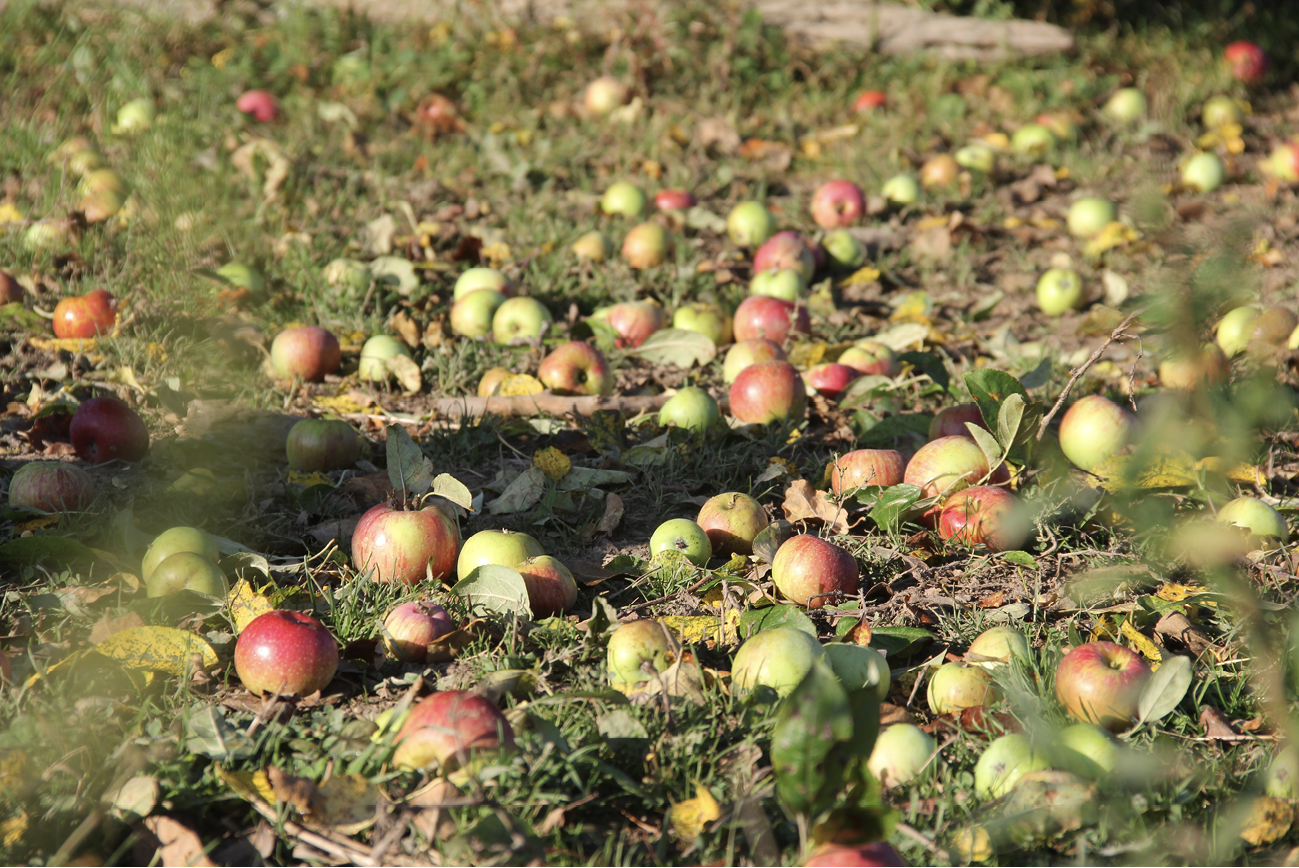
Figure 2.
Wild apples may have wildly differing qualities, and the only way for foragers to know what apples may suit their needs is to taste for sugars, tannins, acids, aromas and textures. Large beautifully coloured fruits may stand out visually, but only tasting will tell if they are useful for eating or cider making.
Photo: Maria Kennedy
Here on this rugged and woody hillside has grown an apple-tree, not planted by man, no relic of a former orchard, but a natural growth, like the pines and oaks. Most fruits which we prize and use depend entirely on our care. Corn and grain, potatoes, peaches, melons, etc., depend altogether on our planting; but the apple emulates man’s independence and enterprise. It is not simply carried, as I have said, but, like him, to some extent, it has migrated to this New World, and is even, here and there, making its way amid the aboriginal trees.6
Thoreau’s anthropomorphised wild apple, whether native crab or migrant European cultivar, becomes an avatar and often interlocutor of the human in search of knowledge of ecologies, landscapes and a wider range of sensory experiences. Thoreau’s wild apples exist at these boundaries of understandings of cultivation, domesticity and society, suggesting that it is the migration of fruit and people that allows expansions not only in qualities of the fruit itself, but in the ability of humans to expand their sensory, and thus metaphysical, experiences:
But it is remarkable that the wild apple, which I praise as so spirited and racy when eaten in the fields or woods, being brought into the house, has frequently a harsh and crabbed taste. The Saunterer’s Apple not even the saunterer can eat in the house. The palate rejects it there, as it does haws and acorns, and demands a tamed one; for there you miss the November air, which is the sauce it is to be eaten with.7
The value that Thoreau attributes to wild apples, then, cannot properly be experienced in domestic spaces and circumstances. The movement of apples and humans into the wild changes them. And yet, it is not that this movement negates human senses or sensibilities; Thoreau also spends time in his essay exploring the aesthetics of the apple. He grounds us in the foundational Romantic idea – that humans are freed in nature, in the wild, to explore the beautiful more fully when escaping the dull restrictions, if not the materials, of civilisation.
Thoreau’s publication of ‘Wild Apples’ in 1862 occurred almost a decade before the publication of a story that catapulted the evolving folk legend of Johnny Appleseed to a national audience. Romantic accounts in publications of the nineteenth century transformed the story of a real person, John Chapman, from an idiosyncratic frontiersman into a folk hero whose plantations of apple trees paved the way for westward American settlement. Historian William Kerrigan’s book Johnny Appleseed and the American Orchard traces the real man – a canny land speculator, trader and trapper, as well as an iconoclastic loner and possible mystic or eccentric – in relation to the emergence of folk legend. John Chapman’s great-great grandfather, Edward Chapman, arrived in New England in 1638 among the Puritan colonists. John was born in Leominster, Massachusetts in 1774 into a colonial landscape that was filling up with settlers. Like many at this time, he decided to seek his own fortune farther west, travelling across New England, New York, Pennsylvania and Ohio, planting seedlings and selling trees to settlers who followed afterward. He ended his days in Fort Wayne, Indiana, in the region known as the Old Northwest, where he was also buried in 1845. His seedling orchards were part of the general process of westward migration of European Americans in North America. The settlers’ primary concern in planting orchards was to establish land claims rather than sophisticated agricultural enterprises.8
At the time of Chapman’s apple planting activities in the newly opening west, American orchard agriculture in the east was evolving towards a more complex horticultural practice, where specialised nurseries propagated and sold fruit trees that had been grafted to replicate particularly prized fruits. Though grafting was known and practised amongst an elite few in early America, it was not broadly implemented amongst farmers of more modest means, who tended to rely on trees grown from seedlings. As historian David Diamond describes, grafting was not always possible during the colonial period:
If grafted apple trees were not immediately available, farmers took the preliminary step of planting seeds to provide future rootstocks to graft upon. Two things were needed to upgrade the seed saplings: live buds or scions from superior trees plus the skill to insert them onto the seedlings. The scarcity of both meant seedling trees pre-dominated throughout the colonial era.9
As grafting and horticultural practices spread in the early nineteenth century, named varieties and cultivars became a larger feature of American agriculture. Horticulturalists were producing grafted trees for sale in the Ohio Valley and the Old Northwest at the same time as John Chapman was planting his seedling nurseries in the more remote reaches of this region.
John Chapman, in this context, was far less influential in the eventual development of orchards and cultivated apple varieties as a profitable form of agriculture than other commercial nurserymen. In 1845, the same year as Chapman’s death, Andrew Jackson Downing, owner of an influential plant nursery in Newburgh, New York, published the seminal work, Fruits and Fruit Trees of North America.10 This book not only influenced the adoption of cultivating grafted fruit varieties amongst farmers, but popularised an ideal of agrarian landscapes integrated into urban and suburban settings as well as on the frontier. In 1848, the American Pomological Society was formed to support the growing trade of apple growers and nurserymen and in 1856, one of the Society’s founders, Charles Hovey, published The Fruits of America.11 In this era of more sophisticated horticultural development, why did Chapman’s legend proliferate?
According to Kerrigan, stories about Chapman circulated after his death in local and regional sources, but it was 26 years later that his story reached a national audience through the publication of ‘Johnny Appleseed – A Pioneer Hero’ by William D’Arcy Haley in Harpers Monthly Magazine in 1871. Haley described Johnny Appleseed as a foil to the typically vigilant and potentially violent frontiersman whose interactions with wilderness were characterised by dominance, control and opportunism. Rather, Appleseed was depicted in terms of his peaceful connection with the wilderness, his interaction with which was imbued with the same qualities as that of an artist:
The frontiers-man, who felt himself sufficiently protected by his rifle against wild beasts and hostile Indians, found it necessary to guard against the attacks of the insidious enemies in the grass by wrapping bandages of dried grass around his buckskin leggings and moccasins; but Johnny would shoulder his bag of apple seeds, and with bare feet penetrate to some remote spot that combined picturesqueness and fertility of soil; and there he would plant his seeds, place a slight inclosure around the place, and leave them to grow until the trees were large enough to be transplanted by the settlers, who in the mean time would have made their clearings in the vicinity. The sites chosen by him are, many of them, well known and are such as an artist or a poet would select; open places on the loamy lands that border the creeks – rich, secluded spots, hemmed in by giant trees, picturesque now, but fifty years ago, with their wild surroundings and the primal silence, they must have been tenfold more so.12
Haley’s description emphasises that trope of Romanticism that idealised nature as an environment for the genesis of beauty, self-knowledge and creative enterprise. This wilderness landscape was full of imaginative possibility. Johnny Appleseed’s legend also noted him as a pacifist. His endeavour to plant trees in the wilderness was framed as unmarred by violence and helpful to the pioneer settlers who came after him. Surrounded by the wondrous trees of a primaeval forest, Appleseed’s endeavours were closer to those of an artist than an entrepreneur.
Kerrigan’s scholarship to uncover the historical man John Chapman in contrast to the legendary figure of Johnny Appleseed has explored in detail the multiple and shifting impositions of meaning piled onto the historically documented realities of Chapman’s life. As Kerrigan argues, in this guise of romantic folk hero, Appleseed’s primitive but pacifist lifestyle and generative tree planting became part of a narrative that extolled the beneficial and creative origins of expansionist, capitalist, agrarian nationalism. The romantic focus on pacifism and creativity also excused and obscured the destruction of forests, the displacement and genocide of Native peoples, and the imposition of a capitalist colonial economy on a so-called wilderness.
Chapman’s legend, then, highlights this Romantic ambiguity between cultivation and wilderness, describing a nation ill at ease with the success of its agrarian expansionism and by extension its subsequent shift to industrialisation. Diamond writes:
Chapman’s wandering from seed plot to seed plot, camping out, and dropping in on settlers did not typify American agrarianism, and his horticultural bona fides are problematic. Yet rather than condemn him as an inauthentic farmer, consider his actual behaviors, the stuff that catalyzed his myth: sleeping in hollow logs, canoeing limpid streams, treading Indian trails, and venerating wildlife. In these, he epitomizes America’s perpetual ambiguity about nature, paradoxically enabling and profiting from its transformation while longing for its purity and preservation.13
By this judgement, as agrarian settler, or frontiersman, Chapman was inconsequential. But as a man traversing these cultivated and wild spaces, he activated an imaginary world of possibility that questioned and critiqued these two foundational characters of the American story of westward settlement: the agrarian settler and the entrepreneurial frontiersman. By the time his story rose to the level of legend in the national media, westward settlement had moved beyond the Ohio Valley and the regions of the Old Northwest to the Great Plains, Rocky Mountains and the Pacific coast. The wilderness of Chapman’s time and place had been domesticated. Far more successful orchards and nurseries had proliferated. In the midst of this success, Americans looked back for inspiration not to the practical nurserymen of their time, but to the figure whose unlikely persistence and creativity in the most inhospitable conditions made the eventual domestication of the landscape appear even more dramatic in hindsight. It is perhaps Johnny Appleseed’s position as an unlikely forefather of the frontier that makes him all the more appealing as a folk hero. Impractical, iconoclastic and individualistic, he becomes an embodiment of the unlikely experiment of westward settlement, throwing its eventual success into more dramatic relief.
As an iconoclastic hero, however, Johnny Appleseed’s legend is open for reinterpretation by those who want to critique the arc of American development rather than celebrate him as an explanation for its genesis. Commenting on Appleseed’s renewed significance in the twenty-first century, Kerrigan argues that this folklorisation process of Appleseed is ongoing, noting the contemporary issues which draw from the legend and re-animate it with fresh significance:
But the apple and Johnny Appleseed are once again emerging as powerful symbols pushing back against the transformations global industrial capitalism continues to bring. The increasing distance of farms and orchards from urban and suburban American, the disappearance of the labor-inefficient but idolized family farm, the relentless outward sprawl of cities into once again agrarian hinterlands, and the dominance of a global agro-industry in the American kitchen face increasing resistance.14
The emergence of Appleseed as a folk hero in nineteenth-century American publications acts as an ever-present background for the emergence of popular discourses of foraging in the twenty-first century. Appleseed’s Romantic qualities are both recapitulated and challenged in contemporary writing where the current appeal of apple foraging draws on and subverts foundational aspects of Appleseed’s legend, especially its romantic characterisation of the wilderness as a site of creative renewal and generative possibility.
The legend of Johnny Appleseed elides many real histories of settlement, agriculture and horticulture, as well as the work of Native peoples who had been cultivating their own crops and orchards on the land that later would be characterised by white settlers as ‘wild’.15 In doing so, the legend simplified and compressed a set of desires and aspirations of Americans in the midst of real agricultural, industrial and national expansion. The Appleseed legend signifies a first example of a Romantic discourse of uncultivated apples arising as a foil to an agrarian discourse of settlement.
Today’s foragers, conversely, go out into the forest in search of the wild seedlings to bring back into domesticated settings. They seek fruit that has gone wild, fruit that has escaped the ruins of cultivation and joined the ecosystems of forests, fields and hedgerows, and which might bring some of its wild qualities to enliven the landscapes of rural America that are in agricultural, economic, or environmental decline. Like Johnny Appleseed, though, they cross between cultivated and wild spaces and, in so doing, spark a new discourse about the significance, utility, meaning and history of cultivated and wild spaces in America, and about the processes of selection, domestication and cultivation of fruits in the development of market economies.
A new cider market and contemporary foraging discourses
In between the first rise of romantic discourses with the publication of Thoreau’s ‘Wild Apples’ and the Johnny Appleseed legend in Harper’s, and the emergence of a foraging practice amongst contemporary cider producers, America witnessed huge changes to agriculture, orcharding and the role of alcoholic beverages. Industrialisation and globalisation contributed to the decline in the diversity of cultivated apple varieties, as did the temporary imposition of Prohibition, rises in the uses of agricultural inputs and chemical controls, and dramatic changes in horticultural practice favouring high-density tree planting in orchards. The orchards of twenty-first-century America are designed to produce reliable fruit crops for the massive fresh-eating and processing markets, rather than to provide for agrarian self-sufficiency. Cider went from being a seasonally produced drink of colonial and westward settlers, to larger commercial production as applejack spirit, to being banned during Prohibition. The production of fresh cider apple juice has remained a seasonal tradition in many communities, and home fermentation continued during and after Prohibition, with a few national brands, such as Woodchuck, continuing as mainstays of the market throughout the twentieth century.
Contemporary discourses of foraging and wild fruit began to emerge in American media shortly after the sudden rise of cider as a renewed category of alcoholic beverage in the twenty-first century American market. They were heavily influenced by the founding in 2010 of Cider Week, a marketing event championing craft producers in New York, which was created and initially nurtured by food and farming non-profit Glynwood. Even more consequential was the nationwide launch of the Angry Orchard brand, owned by Boston Brewing Company, in 2012, which further propelled hard cider into ascendent media coverage and ubiquitous commercial presence on the shelves of many grocery and beverage outlets. In a few short years, cider became a rapidly growing industry, with hundreds of new producers entering the market.16 Amidst a plethora of marketing narratives driving the popularity of this new industry, including historical references to the American founding fathers, Johnny Appleseed, and Prohibition, distinct narratives around wild fruit, wild fermentation and foraging also appeared. ‘Wild’ became a buzzword and ‘foraged’ a badge of authenticity for artisan brands in opposition to mass-market industrial products.
Several media texts illustrate the development of these discourses in North America over a period of seven years. In 2013, the food commentary site Grub Street published a profile of Andy Brennan, who had begun to build a following for his foraged ciders:
Brennan gets his apples mostly via foraging trips. He and Polly scrounge around in the woods and collect the wild apples from branches or off the forest floor. Some are no larger than golf balls, and nearly all are ugly, bruised, bee-stung, and possibly home to worms or other varmints.17
Brennan, who would go on to publish the book Uncultivated in 2019, was a constant presence in the media coverage of the rise of cider as a new and hip beverage category and was often heralded for his foraging activities and his use of wild fruit.
Significant purely for its index of relevance to mainstream popular culture trends, Vogue Magazine featured foraging, wild apples and cider in a short piece in 2015 with this description of the quaintly old-fashioned seasonal beverage positioned next to a model leaning against a tree in a tweedy ensemble:
Now the old guard of artisan and backyard cideries that have always crafted serious juice in (more often than not) bone-dry styles has started to garner the attention it deserves, and up-and-comers are seeking out forgotten and wild apple varieties to add to the diversity of cider expressions available on the market.18
Vogue’s article was followed that same year by a much more substantial article by culinary author Rowan Jacobson on the digital platform Tasting Table. Entitled ‘New American Ciders with the Feral Cider Society’, the article extolled the uniquely American cider vintages to be made by finding fruit at the side of the road:
It’s a century-old tragedy with a happy ending. Sweet apples make boring booze. Making cider out of them is like trying to make wine with table grapes. Great cider requires special varieties, but Prohibition swept those from the American landscape. Now there’s a scramble to find good fruit. Some cider makers have imported varieties from England and Normandy. But a few of us have realized that the most tantalizing fruit of all lines the dirt roads and abandoned cellar holes of rural America.19
Jacobson’s article sought to elevate foraging and wild or ‘feral’ fruit through a more serious consideration of the survival of orchards and feral trees from historical landscapes and the significance of local terroirs, attempting to put cider in a larger conversation with European viniculture and carving out a claim for uniquely American culinary ingredients and tastes. Following his earlier book, Apples of Uncommon Character,20 Jacobsen’s article moved foraging and wild fruit beyond a merely hip new food fad and connected it with elite discourses of culinary culture and conceptions of human-landscape relationships that would find further expression in the writings of foragers themselves. If earlier twenty-first century media accounts indicated a bubbling popular discourse on the topic of wild apples and foraging in relation to the growing cider industry, some foragers began to think more deeply and critically about the practice, resulting in the publication of works speaking to a more internal audience of foragers, orchardists and cider makers.
Self-published in 2017, Matt Kaminsky’s book The Wild Apple Forager’s Guide begins by describing the author’s own fascination with the landscape in which wild apples exist. He writes:
The trees which I have worked most closely with in my few seasons spent working with apples are those populations of wildings, whose independence and wherewithal to survive in society’s unmanaged places presents them openly … We apple foragers exist as the naturalist, the orchardist, and as our inner animal selves simultaneously. In the neglected parts of our landscape, we watch the tree evolve through dormancy, to bloom, through fruit production, graduating with harvest. We get to know the tree inside of the home it has made for itself.21
Kaminsky is an orchardist and homestead farmer in Western Massachusetts and his narrative powerfully echoes the Romantic tropes that characterised the descriptions of Johnny Appleseed’s relationship to wilderness in the Harper’s article of 1871 and Thoreau’s Atlantic essay on ‘Wild Apples’. But Kaminsky’s interaction with the trees is not only framed by this Romantic idea of union with a landscape characterised as unmanaged and sublime, but also one which is neglected. He also sees wild trees as a potential resource but notably as a potential hedge against climate change. In this, he echoes Thoreau’s sense of the agency and possibility of the apple tree:
Amid this childlike wonder of wild apples, I have come to personal conclusions about where we stand with apples today. Climate change is bringing more extreme types of weather into all regions of Planet Earth … The wide genetic variability in apples in easy to see. It affects all aspects of the fruit, as well as the growing conditions that the tree itself can tolerate.22
Kaminsky’s identification of climate change as a motivating factor in his foraging practice catapults twenty-first-century foraging discourses into a new direction. Beyond Romantic creativity, or even culinary taste, his narrative highlights the view of a naturalist: observational, discerning and practical, he sees trees within the context of their reaction to natural selection. Those that survive are worth attention. The genetic adaptability of the apple becomes not only a potential tool in staying ahead of climate change’s effects on agriculture, but a model for humanity’s own capacity to adapt. Once again, it is in the zone of the wild where creativity influences human ideas and exerts a parallel and intertwined agency. But in the twenty-first century, the wilderness as imagined in Johnny Appleseed’s ‘Old Northwest’ is no longer such an obvious opposition to the domesticated landscape of a reforested Northeast, where agrarianism has given way to new landscapes of intensified urban, suburban and agricultural land, while unproductive old agricultural areas give way to second-growth forest. Kaminsky’s connection with nature is forged in these feral boundaries: in zones of reforestation, with wild specimens of cultivated fruits colonising a new ecology.
While Kaminsky’s volume emerged from grassroots practices of foraging and speaks largely to a grassroots audience, Andy Brennan’s book Uncultivated: Wild Apples, Real Cider, and the Complicated Art of Making a Living (2019), reached a wider public. It is a manifesto and personal history of his journey into the forests of upstate New York, finding the feral apples with which he makes his cider. Uncultivated expands the scope of significance for foraging to a larger critique of capitalism:
Land is limited, success is fleeting, seasons change, and multiplicity is a healthy adaptation for survival. These are all natural principles that conflict with Modern humanity’s modus operandi: constant growth, limitless absorption, specialization, the need for certainty. My goal in writing this book is not to rebuke the business or farms that float Modern people (in fact they seem required); I simply want to remind myself and others that another way exists. I’ve been lured down that path and I’ve discovered personal success by emulating the apple trees along the road. They are becoming wild. 23
Brennan is actively exploring the idea of ‘un-cultivation’ – the removal of oneself and one’s environment from expansionist economies and biological interventions. Un-cultivation is not merely the state of the fruit he seeks, but a philosophy for living:
Uncultivation is an action. To uncultivate is to encourage the transformation from one state to another, just like cultivation, except that it seeks its opposite horizon. It seeks to peel back the layers of cultivation … I have no delusions of uncultivating my way back to the Garden of Eden, but I would like to see cultivation return to a place that I feel is healthier.24
Brennan’s philosophy of un-cultivation in practice, beyond his sourcing of fruit, contributes to his complicated presence as an embodiment of foraging in the cider industry media, as well as an important practical mentor for many engaged in foraging today. Part of a network of avant-garde artists and food connoisseurs in the orbit of New York City, he has been able to transform the grassroots, vernacular practice of foraging shared by many people in rural communities in New York25 into an artistic statement and powerful marketing narrative. He was certainly not the first contemporary commercial cider maker to incorporate foraging into his personal or business practice. But framing his activity as an act of art and ideology, rather than merely as a means of subsistence or production, has allowed him to appeal to urbane New York City consumers and to sell 500 ml bottles of cider made from foraged fruit for 45 dollars and more. Brennan’s work in many ways set the tone for ongoing discourses of and practices of foraging. His book can be seen as a philosophical culmination of his media presence, public speaking, art projects and business philosophy and practice.
From a focus on philosophy to a detailed study of foraged fruit, the works devoted to foraging from within the community contributed and further complicated the foraging literary field. In 2020, Kaminsky published a new volume, the first of a planned series, Proceedings from the First Annual Wild and Seedling Pomological Exhibition, in which he expanded the scope of his own foraging work, inviting people to submit apples to his exhibition and publication. The result is a Pomona – an illustrated catalogue of apple varieties, and a genre which has a long history in the study and cultivation of fruit. Most works in the Pomona genre have featured cultivated fruits.26 Kaminsky’s volume focused on wild fruit discovered, named, used and sometimes cultivated by foragers from around North America.27 The series has continued, with the fifth edition due to be released in 2025.
The zine Malus, a publication which shares short articles and creative works by people in the cider industry, acts as a venue for grassroots ideas, philosophy and experience narratives that track contemporary issues in the community of cider makers. Melissa Madden, a cider maker from the Finger Lakes region of New York, brought political dimensions to bear on the ideology and practice of foraging in her essay ‘A Brief (and Potentially Erroneous) History of the Finger Lakes National Forest Apples Commons’. Madden brings our attention back to the circumstances in which apples first came to be cultivated on American land, through the displacement and theft of land and genocide of Indigenous peoples, the process in which John Chapman himself was complicit, and which his folk legend elides. Madden, writing about her foraging activities in the Finger Lakes region of New York and her growing consciousness around the history of the land where she forages, writes:
We know that our colonial heritage includes the destruction of another people’s place. We know we have inherited this earth by decimating the Haudenosaunee’s ability to feed their families in their home places …. When I seek wild apples, I try to keep all this in mind. I consider my own role in the flow of history, the use of this site, and the displacement and disenfranchisement that exists even more strongly now for indigenous people who call this home … This is also a questioning of why I have had such access and what it means when others are deprived. It is a questioning of the wild foraging paradigm in our cider culture, of our reverence for the wild trees and our own uses of their abundance.28
Madden’s article, among others, has highlighted growing interests in addressing issues of social justice and historical inequity in a community characterised by a white majority. Her discussion of foraging was one of the first to introduce a critical, reflexive and revisionist approach to published foraging discourses.
In a break away from the Romantic paradigm, Madden actively subverts the very idea of the ‘wilderness’, reminding us that Native peoples inhabited and cultivated these spaces before white settlement, and that they are sites not only of inspiration, but also of painful memories of dispossession. Her work significantly complicates the discourses of foraging; perhaps it can be seen as finally puncturing some of the discomfort with American expansionism that nineteenth-century literature and legend attempted to stitch together. Madden’s article shows us the Romantic imagination uncomfortably ripped open. Her trips into the forest in search of wild fruit are still imbued with creative power and communion with the natural world. However, that world is no longer empty, and its history is no longer peaceful. Her wild apples inspire a new agency, where her writing becomes a process of reckoning with an unquiet past and an uncertain future.
Conclusion
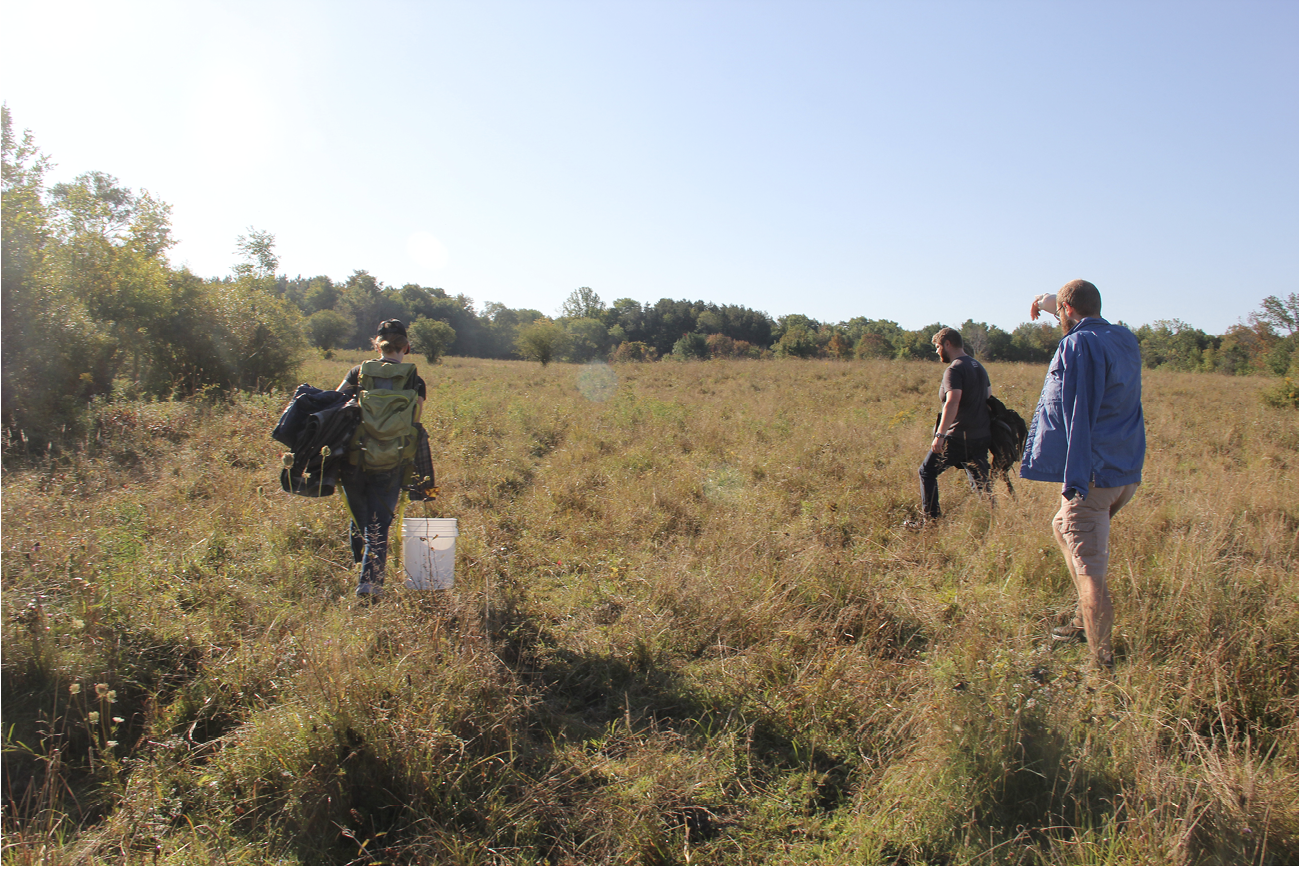
Figure 3.
Apple foragers at a location in upstate New York head out to their foraging locations with buckets and backpacks and will carry their harvest across fields to vehicles parked on a quiet gravel road.
Photo: Maria Kennedy.
The discourses of foraging outlined here illustrate layers of stories told in American society about human interactions with nature. Contemporary foraging discourses confound simplistic binaries of cultivated and wild landscapes. Andy Brennan’s term ‘uncultivated’ introduces the complex recursions of history, agency and innovation that have become a feature of twenty-first-century foraging discourses. In the shift from the Romantic wildness that characterised Thoreau’s ‘Wild Apples’ and D’Arcy’s legend of Johnny Appleseed towards the revisionist Romanticism that inflects the writings of contemporary foraging, we see a transformation of emphasis from a creativity residing primarily with humans, accessed through contact with nature, towards Thoreau’s understanding of creativity and agency residing in nature itself. Current foraging literature is expanding this approach, suggesting humans must act responsively and responsibly in order to benefit from resources that are intrinsic to the natural world, while also recognising their place in a longer line of historical interactions between different peoples in changing environments.
Blurring the boundaries between wild and cultivated landscapes, between private property and the commons, between industry and ecosystem, the emergence of contemporary foraging discourses suggests that old polarities of meaning are in flux. These accounts illustrate the emergence of new or contested ideological models for expressing the value of relationships between people and nature in a changing American landscape, where climate change is imminent, inequities in access to land are increasingly scrutinised, and the resources of rural communities are stretched. Such narratives return to Thoreau’s proposition that wild apples may be sources of economic, spiritual, social, environmental renewal, even as cider makers strive to make a living in the midst of landscapes impacted by colonisation, cultivation and industrialisation. Furthermore, this literature argues that ‘uncultivated’ or ‘forest’ areas where wild apples can be found today exist due to the agriculture labour and resources that have been introduced and abandoned in the wake of waves of European settlement. It is this encounter, between cultivated and uncultivated, between civilisation and wilderness, that creates a zone of tension, wonder, creativity, curiosity and desire with relation to the American landscape, and where new generations find opportunities to reshape their own relationships to both the historical past and to the community, commerce and environment they wish to build today.
One might wonder if contemporary foraging discourses situate foragers as the heirs to Appleseed? Are they completing his creative task of generating a new American landscape by bringing apples back out of the wilderness to re-invigorate the depleted domesticated landscapes we have created in the last two centuries? Or, are foragers heirs to Thoreau? Thoreau certainly thought he would have no heirs to his celebration of and transformation through communion with wild apples29 as he could not see beyond the transformations of landscape and economy occurring in his own time. Seeking an interpretation of contemporary foraging that casts foragers as successors to Appleseed and Thoreau would suggest an ongoing, revised Romanticism is still at work, correcting the flaws of manifest destiny, but still seeking an agrarian synthesis between the wild and the cultivated landscapes of America. In the current foraging literature, critiques of progress, productivity and individuality suggest that the old Romantic paradox between wilderness and domestication, between preservation and profit, is opening up new directions for what wild apples can be in the American imagination, and how foraging might lead us to new landscapes and ways of living in a more expansive relationship to the past and a more dynamic imagination of the future where ‘un-cultivation’ may be a discourse and a practice that is simultaneously creative, uncomfortable and responsive to needs for social, environmental and economic change.
ACKNOWLEDGEMENTS
This paper is written as part of a larger project funded by the Einhorn Center for Community Engagement at Cornell University, in collaboration with our research team at Cornell led by Dr Gregory Peck, with undergraduate assistants Victoria Broughton and Andrew James, lab technician Michael Brown, and with community partner the New York Cider Association, represented by executive director Scott Ramsey.
Maria Kennedy is an Assistant Teaching Professor in the Department of American Studies at Rutgers University New Brunswick. She received her Ph.D. in Folklore and Ethnomusicology from Indiana University Bloomington. Her work focuses on public practice, heritage, conservation and landscape in Britain and North America.
Email: maria.kennedy@rutgers.edu
1 A. Brennan, Uncultivated: Wild Apples, Real Cider, and the Complicated Art of Making a Living (White River Junction Vermont: Chelsea Green Publishing, 2019).
2 M. Calvert, E. Cole, C. Neill, A. Stewart, S. Whitehead and J. Lahne, ‘Exploring cider website descriptions using a novel text mining approach’, Journal of Sensory Studies 38 (5) (2023).
3 Ibid.
4 D.H. Diamond, ‘Origins of pioneer apple orchards in the American West: Random seeding versus artisan horticulture’, Agricultural History 84 (4) (2010): 423–50, at 444.
5 H.D. Thoreau, The Succession of Forest Trees, and Wild Apples / by Henry D. Thoreau. With a Biographical Sketch by Ralph Waldo Emerson (Boston, MA: Houghton, Mifflin and Company, 1887).
6 Ibid. p. 63.
7 Ibid. p. 75.
8 W. Kerrigan, Johnny Appleseed and the American Orchard: A Cultural History (Baltimore: Johns Hopkins University Press, 2012).
9 Diamond, Agricultural History, p. 428.
10 A.J. Downing, The Fruits and Fruit Trees of America; or, The Culture, Propagation, and Management, in the Garden and Orchard, of Fruit Trees Generally; with Descriptions of All the Finest Varieties of Fruit, Native and Foreign, Cultivated in This Country (New York): Wiley and Putnam, 1845).
11 C.M. Hovey, The Fruits of America: Containing Richly Colored Figures, and Full Description of All the Choicest Varieties Cultivated in the United States (Boston MA: C.C. Little and Jas. Brown, and Hovey & Co, 1856).
12 W.D. Haley, Johnny Appleseed: A Pioneer Hero (Fort Wayne, IN: Public Library of Fort Wayne and Allen County, 1955), p. 4.
13 Diamond, Agricultural History, p. 444.
14 Kerrigan, Johnny Appleseed.
15 M.D. Abrams and G.J. Nowacki, ‘Native Americans as active and passive promoters of mast and fruit trees in the Eastern USA’, Holocene 18 (7) (2008): 1123–37; W. Kerrigan, ‘Apples on the border: Orchards and the contest for the Great Lakes’, Michigan Historical Review 34 (1) (2008): 25–41.
16 C.A. Miles et al., ‘Growing apples for hard cider production in the United States – trends and research opportunities’, HortTechnology 30 (2) (2020): 148–55.
17 G. Gray, Wild Man: Meet New York’s Hottest Cider Producer (2013): https://www.grubstreet.com/2013/10/andy-brennan-best-cider-producer.html
18 C. Demmond, ‘Why hard cider is making a comeback’. Vogue, 10 Nov. 2015: https://www.vogue.com/article/hard-cider-fall-drink-cocktail-food.
19 R. Jacobsen, ‘New American ciders with the Feral Cider Society’. Tasting Table, 9 Nov. 2015:https://www.tastingtable.com/691087/cider-bitter-apple-cider-aaron-burr-cidery-shacksbury-cider-finger-lakes-apple-tree-project/.
20 R. Jacobsen, Apples of Uncommon Character: 123 Heirlooms, Modern Classics, & Little-Known Wonders (First US edition. New York: Bloomsbury, 2014).
21 M. Kaminsky, The Wild Apple Forager’s Guide (Massachusetts: Self-Published, 2017).
22 Ibid.
23 Ibid., p.vi.
24 Ibid.
25 M.E. Kennedy, ‘Fruit in the forest: Foraging apples and pressing cider in the Finger Lakes’, Voices 43 (3/4) (2016): 17–22.
26 Two of the most significant Pomonae in England are T.A. Knight, Pomona Herefordiensis: Containing Coloured Engravings of the Old Cider and Perry Fruits of Herefordshire. With Such New Fruits as Have Been Found to Possess Superior Excellence. Accompanied with a Descriptive Account of Each Variety (Agricultural Society of Herefordshire, 1811); and R. Hogg and H.G Bull, The Herefordshire Pomona, Containing Original Figures and Descriptions of the Most Esteemed Kinds of Apples and Pears (Hereford: Jakeman and Carver, 1876).
27 M. Kaminsky, Proceedings from the First Annual Wild & Seedling Pomological Exhibition (Massachusetts: Self-Published, 2021).
28 M. Madden, ‘A brief (and potentially erroneous) history of the Finger Lakes National Forest Apple Commons’, Malus 9 (2020): https://www.maluszine.com/essays/an-apple-commons#/
29 Thoreau, The Succession of Forest Trees, p. 83.